Unit 5 · Contents
Mental and Physical Health
Understand health and stress. Compare explanations, classifications and treatments carefully.

Watch Unit 5 Review
Get Psyched · Unit 5 video review
Open on YouTube If the player is blocked, open the review directly.
Health, Context, Classification and Care
Mental and physical health connect bodily regulation, behavior, thought and social conditions. This unit asks how demands affect health, what supports well-being, how patterns of distress are explained and classified, and how treatment can improve functioning. The questions connect, but they are not interchangeable: experiencing stress is not automatically having a disorder, and a diagnosis does not identify one inevitable cause or one guaranteed treatment.
Health psychology begins with demands, appraisal, physiological response and coping. Positive psychology then examines strengths, gratitude, resilience and possible growth. These areas examine resources as well as difficulties. The static concept map groups the questions around the person and context; its links mean “relevant to one another,” not a required sequence from stress to illness.
Classification asks which pattern is present and how it affects functioning. Psychological perspectives and interaction models ask why a pattern may develop or persist. The selected disorder categories provide concrete distinctions among developmental, perceptual, mood, anxiety, dissociative, trauma-related, eating and personality patterns. Learn the mechanism and the qualification together rather than matching one behavior to a label.
Treatment brings evidence, ethical responsibilities and a collaborative relationship to those needs. Psychological approaches, medication and other biological interventions operate through different mechanisms and may be combined. Mr. Steadman and Stark guide the reading; all symptom descriptions are original contextualized examples, and neither character is presented as a clinical case. Nothing in this review asks students to screen themselves, diagnose others or choose treatment.
Five Connected Questions About Health
The five questions connect through the person’s body, behavior and circumstances.
Relationship shown: Related questions about health and functioning.
How do demands, appraisal, bodily responses and coping relate to physical wellness?
What supports well-being, resilience, meaningful strength use and possible growth?
How do professionals describe a pattern and evaluate interacting explanations?
Which symptom domains, courses and distinctions characterize the required categories?
How can evidence, ethics, collaboration and different mechanisms support care?
Identify the relevant details, explain the process or theoretical proposal, and state what the example supports.
Explore the Labs
Five experiences to connect the ideas in this review.
Stress Response Lab
Follow appraisal, stress responses and the limits of the evidence.
Explore →Topic 5.2Coping & Well-Being Studio
Explore coping, strengths and adjustment through fictional situations.
Explore →Topic 5.3Disorders Foundations Studio
Investigate evidence, context and explanatory perspectives.
Explore →Topic 5.4Disorder Categories Explorer
Compare patterns and distinguish observations from classification.
Explore →Topic 5.5Treatment Approaches Studio
Compare treatment approaches, evidence and ethical boundaries.
Explore →Health Psychology
Introduction to Health Psychology
Health psychology connects behavior, thought, emotion and social circumstances with physical health. Stress illustrates how a demand can affect both mental activity and bodily regulation.
CED Printed pp. 114–115Health Is a Relationship Among Body, Behavior and Context
Health psychology studies how psychological processes and behavior relate to physical health, illness and wellness. A health psychologist might examine why people maintain sleep routines, how beliefs affect adherence to medical care, or how social conditions make a healthy behavior easier or harder. Wellness involves functioning and prevention as well as responding to illness; it is not simply the absence of a diagnosis.
Consider a person managing a demanding work schedule. Knowledge about sleep matters, but so do expectations about availability, habits of checking messages, safe housing and whether the person controls working hours. An explanation focused only on willpower would miss these interacting influences. Health psychology can connect a biological need with learned behavior and the social opportunities available to meet it.
Mental and physical health also influence one another. Pain can disrupt sleep and concentration; anxious anticipation can increase muscle tension; supportive relationships can help someone manage a difficult health routine. These are possible relationships, not reasons to assume a physical complaint is imaginary. Psychological contributions and medical conditions can coexist.
Stressors, Appraisal and Accumulating Demands
A stressor is a demand or event that can elicit stress. Stress involves psychological and physiological responses to demands perceived as challenging or threatening. The event and its interpretation are related but different: preparing for an eagerly anticipated performance can involve the same deadline that another person experiences as overwhelming. Resources, past experience and perceived control help shape the response.
Eustress is stress experienced as motivating or constructive; distress is stress experienced as debilitating or harmful. These terms describe how the demand is experienced and its effects, not permanent categories of events. A manageable challenge can become distressing when it persists, combines with other demands or exceeds available resources.
Daily hassles are recurring ordinary frustrations, such as repeated transport delays or competing tasks. Their accumulation can matter even if no single event appears dramatic. Traumatic stressors involve severely threatening or harmful experiences. Adverse childhood experiences (ACEs) are potentially traumatic childhood experiences, including abuse, neglect and major household adversity. They can affect stress regulation, behavior and health across the lifespan. Population-level risk is not an individual destiny: stable relationships and safer environments can provide protection, and the course does not ask students to count their own experiences.
Stress is linked with heightened susceptibility to illness and with physiological problems such as hypertension (persistently high blood pressure), headaches and impaired immune functioning. Repeated autonomic and hormonal activation can strain regulation; disrupted sleep and changes in health behaviors can also contribute. The immune system does not simply switch off whenever someone feels stressed: effects vary with duration and the immune process measured. A stress association does not establish stress as the sole cause of a disease.
| Distinction | What It Describes | How to Interpret It |
|---|---|---|
Stressor / stress | The demand / the response to it. | How to Interpret ItThe same event can elicit different responses in different circumstances. |
Eustress / distress | Motivating challenge / debilitating strain. | How to Interpret ItAn event can shift from manageable to overwhelming over time. |
Daily hassle / traumatic event | Recurring ordinary demand / severely threatening experience. | How to Interpret ItBoth can matter; these are not interchangeable measures of severity. |
Risk / inevitability | Increased probability / a guaranteed outcome. | How to Interpret ItAn ACE or stressful history does not predict one person’s future with certainty. |
A demand, its interpretation and its response are distinct parts of stress.
General Adaptation Syndrome: Alarm, Resistance and Exhaustion
General adaptation syndrome (GAS) is a model of the body’s response to sustained stress. It describes alarm, resistance and exhaustion. A model organizes an expected pattern; it is not a clock that every individual follows for the same number of hours, nor a diagnostic test based on someone’s expression.
In the alarm reaction, encountering a stressor mobilizes a response. Sympathetic activation can increase heart rate and direct energy toward immediate action. Fight–flight–freeze names several possible defensive responses: confront a threat, escape it or become still. Freeze does not mean the person calmly chose inaction. The responses are alternatives or combinations, rather than three mandatory chronological steps.
During resistance, the demand continues and the organism works to cope. Some functioning can appear relatively normal while physiological effort remains elevated. Maintaining attention on a prolonged problem and sustaining bodily readiness draw on resources. Resistance does not mean that the stressor has been removed or that the person is immune to its effects.
During exhaustion, sustained demands can outstrip resources and the ability to maintain the stress response declines. Fatigue and vulnerability to illness may increase; the CED identifies this as the stage of greatest illness susceptibility within the model. Its wording also places exhaustion when stress subsides or resources are spent. Ending a demand can leave a person tired, but successful recovery is not inevitably pathological exhaustion. The diagram distinguishes the model’s depletion pathway from recovery after a manageable demand.
Read the schematic from the first encounter through continued effort to depleted capacity. Its vertical dimension is qualitative capacity to resist a sustained demand, not a cortisol concentration, pulse reading or illness probability. Its line represents a theoretical pattern and has no measured participants or numerical stage lengths. The posture illustration supplies a reading cue; posture cannot identify a physiological stage in a real person.
GAS: A Qualitative Sustained-Stress Schematic
Encountering a demand, sustaining effort and becoming depleted distinguish the three stages of the model.
Relationship shown: Alarm → resistance → possible exhaustion under a sustained demand.

A demand is encountered; defensive mobilization can include fight, flight or freeze.
Effort continues while the demand remains; elevated capacity does not mean effort is cost free.
Depleted resources reduce capacity and increase illness vulnerability within the model.
Vertical axis
Capacity to resist the demand · qualitative levels
Horizontal axis
Progression of a sustained stress response · qualitative stages
On small screens, scroll the diagram sideways to inspect the larger keys. The full key is below.
- SolidTheoretical capacity under sustained demand
- 1 · Alarm
- 2 · Resistance
- 3 · Exhaustion
- A · Depleted
- B · Usual
- C · Elevated
How to read this: The line briefly dips during alarm, rises as resources are mobilized, remains elevated through resistance and falls with sustained depletion. The dashed horizontal line marks usual capacity. The categories are qualitative; no length or height estimates a real person’s time, hormone level or probability of illness.
| Stage | What Changes | Common Misreading |
|---|---|---|
Alarm | A demand is encountered and defensive mobilization begins. | Common MisreadingFight, flight and freeze are not a required three-step sequence. |
Resistance | Sustained coping maintains effort while the demand persists. | Common MisreadingLooking functional does not prove there is no physiological strain. |
Exhaustion | Resources may be depleted and illness vulnerability is greatest in the model. | Common MisreadingA short tired feeling after every challenge is not proof of exhaustion. |
GAS describes a conceptual response to sustained stress; it does not measure a person’s current health.
Stress Can Also Elicit Care and Connection
Tend-and-befriend theory proposes that stress can elicit caring for oneself or others and seeking social connection. Tending can protect or support someone facing a demand; befriending can build a network that provides information, practical help or comfort. These responses can occur alongside defensive mobilization rather than replacing every fight–flight–freeze response.
The CED says the pattern seems to occur mostly in women. The original theory emphasized female affiliative responses and their possible biological and social contributions. Treat this as a qualified proposed pattern, not a rule about every woman or a prohibition on men seeking support. Individual circumstances, caregiving roles and access to trustworthy others matter.
After a community disruption, a person might check on a neighbor and contact friends to coordinate help. The relevant mechanism is care and affiliation under stress. A person who instead takes immediate protective action is not demonstrating a defective coping style simply because the response looks different.
Care and Connection Under Stress
Tending can support one’s own needs or another person; befriending can strengthen access to support.
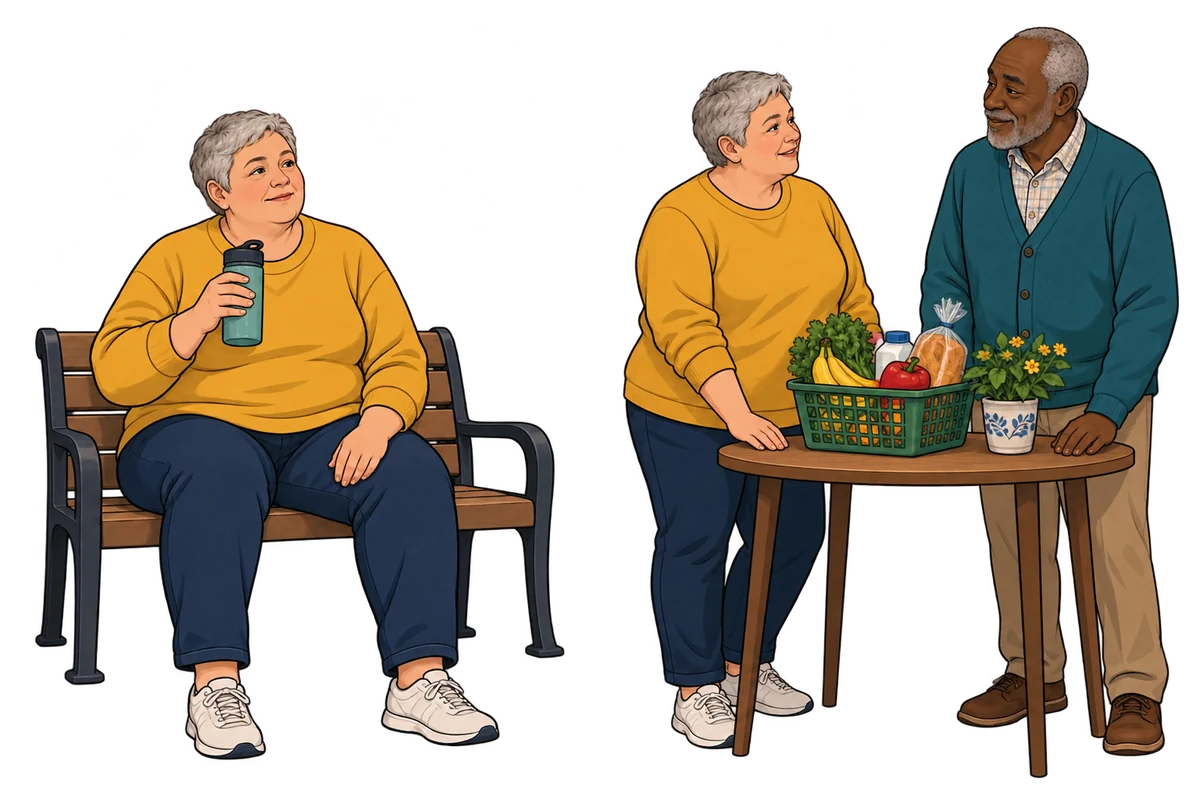
Taking a rest and attending to basic needs illustrate tending.
Checking on a neighbor and sharing practical help combine tending with connection.
Coping Targets the Demand, the Emotional Response, or Both
Coping consists of efforts to manage demands and their effects. Problem-focused coping works on the stressor: identifying a solvable obstacle, comparing possible solutions and acting to change the situation. Clarifying responsibilities or arranging alternative transport can reduce a demand rather than only alter how it feels.
Emotion-focused coping works on emotional reactions to the demand. Breathing practices, meditation or talking with a supportive person can help regulate arousal or distress. The CED also includes medication aimed at stressful emotional responses; that is a professional treatment example, not a recommendation for a student to choose or take medication.
The distinction is the target of the effort, not whether an action appears active or passive. Taking a quiet pause can actively regulate emotion; contacting someone can solve a transport problem or provide emotional support, depending on the purpose. Both approaches can be combined. When a situation is changeable, problem solving may reduce the source; when it cannot be immediately changed, emotion regulation can help a person function while the demand remains.
Coping effectiveness depends on fit, timing and consequences. Temporarily reducing distress through avoidance can leave the original demand untouched and sometimes strengthen future avoidance. Emotion-focused coping is therefore not synonymous with denial, and problem-focused coping is not guaranteed to succeed in an uncontrollable situation.
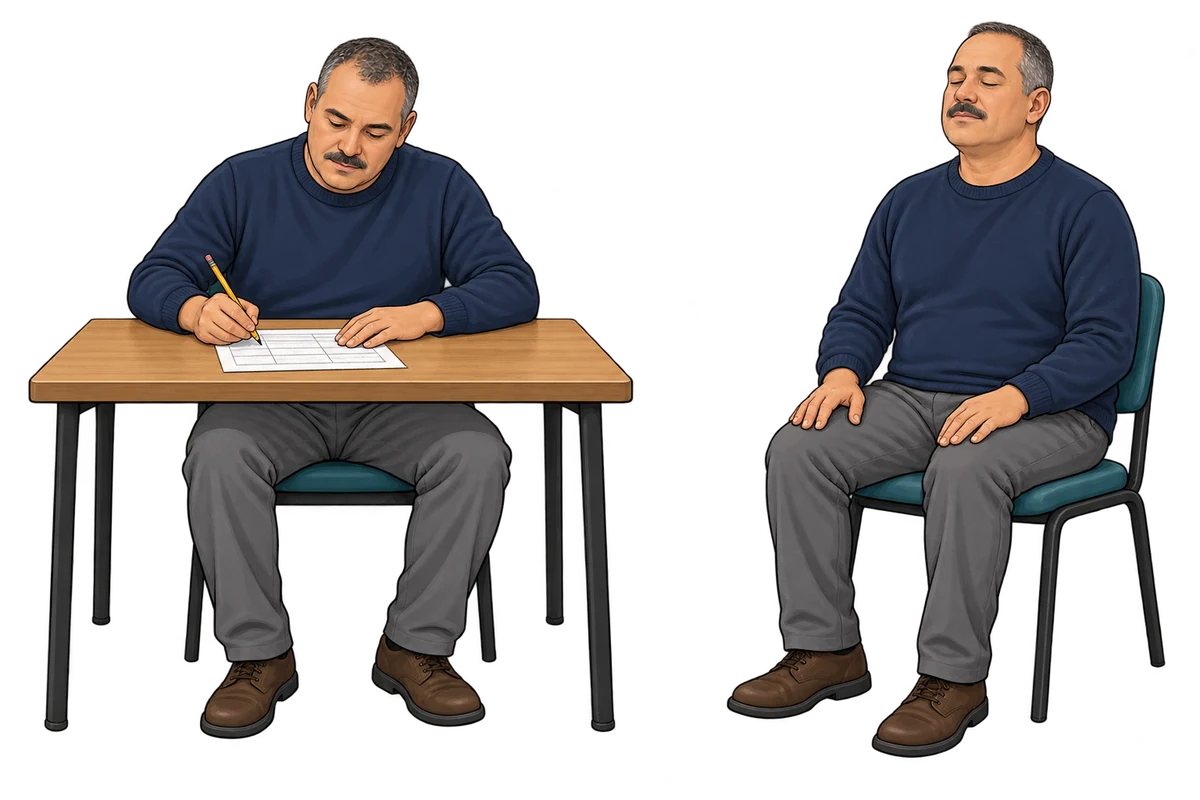
Planning works on a demand; a calm pause works on emotional arousal.
| Coping Target | Illustrated Action | Why It Fits |
|---|---|---|
Problem focused · left | Reviewing a schedule and planning alternatives. | Why It FitsThe effort works on the source of a demand. |
Emotion focused · right | Taking a calm breathing pause. | Why It FitsThe effort works on the emotional response. |
Problem-focused coping addresses the demand; emotion-focused coping addresses the emotional response.
Stress Response Lab
Follow appraisal, stress responses and the limits of the evidence.
Stress Response Lab
The Explanations, Without the Interactions
Health psychology connects physical health and wellness with behavior, thoughts, emotions and social circumstances. Stress illustrates those connections: a demand, its appraisal and the bodily response are related but different. This lab supplies no health assessment, personal history, clinical score or prediction.
One connected fictional illustration: Solenne, a fictional adult organizer, is preparing a community workshop. An unexpected room-arrangement change interrupts the preparations. The same organizer and event continue across the lab. Later views are authored alternatives, not a clinical record or an inevitable personal history. Art is an explanatory cue; posture alone cannot identify a subjective experience, physiological stage or automatic response.
General Adaptation Syndrome · A Classic Conceptual Model
GAS organizes alarm, resistance and possible exhaustion under sustained demand. Not every stressor leads through all three, and there is no universal biological timetable.
Alarm
Illustrated Event: The new room notice arrives. Solenne turns toward it, alert, with shoulders raised and an open hand.
An initial encounter can mobilize sympathetic activity: heart rate, breathing and muscle readiness can increase. Fight, flight or freeze are possible alternatives, not required steps or a conscious menu.
Acute mobilization can support responding to a demand. Posture does not measure a hormone, identify a physiological stage or establish illness.
Interpretation Limit: The picture is an authored cue. Real responses vary, and not every stressful experience continues through all three stages.
Resistance
Illustrated Event: The arrangement issue remains unresolved. Solenne leans over the table and keeps organizing materials.
In the classic model, the organism continues adapting while drawing on resources. Activity may look organized even while physiological effort remains elevated.
Maintaining effort is not cost free. Duration, opportunity for recovery and other circumstances matter; looking functional does not prove an absence of strain.
Interpretation Limit: Resistance is not immunity to illness, proof that the problem is solved or a measured score of personal resilience.
Exhaustion
Illustrated Event: In this prolonged-demand branch, adequate recovery has been limited. Solenne sits with lowered shoulders, resting a cheek on one hand.
The classic GAS model describes depleted resources and reduced capacity to maintain the response. The CED identifies exhaustion as the stage of greatest susceptibility to illness within this model.
Fatigue and vulnerability may increase. This does not diagnose a disease, predict that Solenne will become ill or mean that every tired person has reached a biological stage.
Interpretation Limit: The CED places exhaustion when stress subsides or resources are spent. Recovery after a manageable demand ends is a different circumstance; relief does not automatically cause pathological exhaustion.
Recovery After Resolution · Separate Comparison
In this alternative, the arrangement problem is resolved and demands become manageable. Solenne stands more at ease beside an orderly table.
When a manageable demand ends, mobilization can subside and recovery can occur. This comparison separates relief from the prolonged-demand depletion branch.
There is no guarantee of an immediate return to a particular health state. The alternative line is explanatory, not a measured recovery curve.
This is a separate comparison, not a fourth GAS stage, a cure animation or a rule that all people recover at the same rate.
Reading the graph: Vertical: Capacity to Resist the Demand · Qualitative. Horizontal: Passage Through the Modeled Stress Response. The teal curve briefly dips during alarm, rises with mobilization, stays elevated through resistance and falls under prolonged depletion. The dashed usual-capacity line is a qualitative reference. The gold alternative returns toward usual capacity after resolution; it is not a measured recovery trajectory. A classic conceptual model. Neither axis has measurement units. Spacing is not elapsed time; height is not cortisol, anxiety, immune activity or illness probability.
Stressors, Appraisal and Accumulation
A stressor is a demand or event that can elicit stress. Eustress describes stress experienced as motivating or constructive; distress describes debilitating or overwhelming stress. The same event can be experienced differently as demands, appraisals and resources change. Eustress can still involve physiological arousal; all stress is not automatically harmful.
Manageable Challenge
Authored Account: Solenne reports: “This is demanding, but I feel motivated and can manage the preparation.”
The materials are arranged, responsibilities are clear and there is time for preparation and recovery.
This authored account illustrates eustress: stress experienced as motivating or constructive in the relevant circumstances. A physiological stress response can still occur.
An organized table or relaxed pose alone cannot establish eustress. The account, demands and available resources supply the interpretation.
Overwhelming Demands
Authored Account: Solenne reports: “The competing demands feel overwhelming, and I am struggling to keep up with ordinary preparation.”
The same event now has unclear responsibilities, a late change and too many competing demands for the available resources.
This authored account illustrates distress: stress experienced as debilitating or overwhelming. The event itself is not universally distressing.
A raised shoulder does not reveal subjective experience. Stressor appraisal and circumstances matter; there is no personal rating or diagnosis here.
Repeated Daily Hassles
Authored Account: Small logistical difficulties arrive while Solenne continues preparing. Inspect each event and the work still awaiting attention.
Ordinary frustrations can repeat or overlap. An individual hassle need not be dramatic for an accumulation of unresolved demands to matter.
The board tracks actual fictional event and task records. More pending tasks can mean more work to manage, but counts do not establish distress, disease or a physiological dose.
Marking a task handled changes the paper record. It does not calculate or reset Solenne’s stress response.
Extended Unresolved Demands
Authored Account: In this alternative, the room issue and preparation demands persist with limited opportunities for recovery.
Duration, repetition and the wider context matter, rather than the size of one isolated inconvenience.
Chronic stress concerns ongoing or recurring demands and responses over time. Prolonged activation and disrupted sleep or health behavior can contribute to health problems.
The tired illustration supplies no diagnosis or prediction. A short challenge does not automatically become chronic stress or GAS exhaustion.
Daily hassles are ordinary frustrations that may repeat or accumulate. The paper board reveals these events: A Room Query Arrives; The Packets Are Not in Their Usual Place; A Delivery Is Delayed; Some Labels Need Replacing; The Room Query Returns. Five event records concern four distinct tasks because the room query repeats. A newly pending task adds one record; an already pending task is not counted twice. Marking a task handled removes it from the pending list; a later follow-up can reopen it. Counts describe work records only, never stress, immunity or illness risk.
Stress and Physical Health
Stress is a factor in heightened susceptibility to illness. Prolonged autonomic/hormonal activation, disrupted sleep, health behavior and environmental conditions can contribute. Associations do not establish stress as the sole cause of a disease or predict one person’s outcome.
Hypertension
Hypertension means persistently high blood pressure.
Stress is linked with hypertension. Repeated autonomic and hormonal activation, health behavior and broader circumstances can contribute to cardiovascular strain.
A brief rise in blood pressure during acute mobilization is not the same as a diagnosis of hypertension. Stress is not its only cause; this lab measures no blood pressure.
Headaches
Headaches can have many contributing factors.
Long-term stress may contribute to or worsen headaches. Muscle tension, disrupted sleep and other factors can be relevant.
Neither a pose nor a pending-task count establishes a headache, its cause or a medical condition. The illustration does not predict symptoms.
Immune Suppression
Immune suppression describes reduced aspects of immune functioning.
The CED links stress with immune suppression. Chronic stress can dysregulate immune responses and suppress some protective functions; effects depend on duration and the process measured.
The immune system does not simply switch off whenever stress occurs. Acute and chronic effects can differ, and changes may also include inflammation. No immune-cell count or infection probability is supplied.
Possible Responses · Alternatives, Not a Required Sequence
Fight, flight and freeze describe possible response patterns associated with encountering a perceived threat or stressor. They are not permanent personality types, a menu of conscious choices or three steps everyone must complete. The harmless authored alternatives provide context rather than inducing a response in the student.
Fight
Action: Solenne leans toward the table and raises an open palm, saying “Wait.” No violence or physical confrontation occurs.
Authored Account: The authored account describes a sudden urge to confront the interruption, before deliberate planning.
Context: An unexpected room change is perceived as urgent. The situation is harmless; the example illustrates possible mobilization, not a required response to an event notice.
Confrontational defensive mobilization toward a perceived threat or stressor.
An assertive gesture can also have other meanings. The authored account/context support this illustration; a raised hand alone does not identify an automatic response.
Flight
Action: Solenne turns away from the table toward open space, shifting back from the immediate interruption.
Authored Account: The authored account describes an immediate urge to withdraw, rather than a previously planned break.
Context: This is an alternative response to the same unexpected interruption, not what happens after the Fight picture.
Withdrawal or escape-related mobilization away from a perceived threat or stressor.
Moving away can also be deliberate coping or ordinary movement. Its purpose and context matter; no response is inferred from posture alone.
Freeze
Action: Solenne briefly becomes still, with hands paused near the materials and attention fixed on the changed arrangement.
Authored Account: The authored account describes momentary automatic stillness, rather than choosing to pause and plan.
Context: This is another possible immediate response. No panic, trauma or physical danger is simulated.
Defensive stillness or inhibited movement in response to a perceived threat or stressor.
Stillness is not automatically freezing, weakness or a conscious decision to do nothing. A thoughtful planning pause does not establish this response.
Tend-and-Befriend
Action: Solenne attends to an immediate need and contacts the volunteer team to check what others need and seek support.
Authored Account: The authored account emphasizes care, connection and mobilizing social support in response to stress.
Context: The CED describes this as a reported tendency occurring mostly in women. It is a qualified group-level theoretical pattern, not a rule determined by sex or gender. No such identity is inferred for Solenne.
A theory emphasizing tending to one’s own or others’ needs and seeking connection in response to stress.
Care and connection can coexist with defensive mobilization. They are not universal, restricted to one group or automatically more virtuous than other responses.
Sources, Curriculum and Scope
Verified October 14, 2026. Current CED: Fall 2025 cover, inner Fall 2024 title; Topic 5.1 printed pp.114–115, zero-based PDF pages120–121. October 2025 clarifications do not change this topic. Ten official records: four learning objectives and six EKs. There is no 5.1.A.1.
- College Board · Official CED
- College Board · Clarifications
- NIMH · Stress Factsheet
- APA · Stress and the Body
- NCCIH · Stress
- CDC · Adverse Childhood Experiences
- Segerstrom & Miller · Stress and Immune Function Meta-analysis
- Taylor and Colleagues · Original Tend-and-Befriend Theory
The CED’s exhaustion wording is retained with the recovery/depletion distinction. The immune source supports duration/function qualifications; no study result or effect estimate is reproduced. Illustrations, dialogue, task records and drawing coordinates are authored teaching representations, not participant observations, clinical records or measured physiology. New Stress Response material awaits Tim’s review.
Positive Psychology
Positive Psychology
Positive psychology asks what supports well-being, resilience and a meaningful life. Its questions complement the study of distress and disorders; a positive experience does not erase difficult circumstances.
CED Printed pp. 116Studying What Helps People Function and Flourish
Positive psychology investigates factors associated with well-being, resilience, positive emotion and psychological health. Well-being includes people’s evaluation of their lives and experiences of positive and negative emotion; functioning and meaning are also useful questions. Resilience is adaptation in the face of adversity, not an absence of painful emotion or a fixed trait that guarantees success.
The field can ask whether gratitude or using a personal strength improves a reported outcome. Answering requires defined measures and appropriate comparison conditions. A testimonial illustrates a person’s experience; it cannot establish that an intervention produces the same effect for everyone. Positive psychology remains subject to the same research standards as other psychological approaches.
Subjective well-being concerns a person’s own evaluation and feelings. An objective indicator is an externally observed or recorded condition, such as attendance or access to a resource. The CED’s strengths statement calls happiness and subjective well-being “positive objective experiences.” Those examples are typically subjective outcomes; this review retains the listed relationship while making the measurement distinction explicit.
Gratitude Directs Attention Toward What Is Valued
Gratitude is appreciation for a benefit, contribution or valued aspect of life. Expressing it can involve acknowledging another person’s help or reflecting on a specific positive experience. The proposed relationship with subjective well-being is understandable: attention to valued events and recognition of support can influence appraisal, emotion and relationships.
The CED presents gratitude as increasing subjective well-being. Research supports benefits in some structured interventions, while effect size, duration and individual response depend on the study and comparison. Gratitude does not require denying injustice, suppressing grief or claiming that all harmful experiences should be appreciated.
A person who writes a specific thank-you message to someone who explained a difficult task is expressing gratitude toward an actual contribution. The benefit is not merely writing any positive sentence. To infer an intervention effect, researchers would need to compare outcomes under defined conditions rather than assume that a happier participant proves the technique caused the change.
Gratitude Names a Contribution
The writer connects appreciation with a particular contribution, rather than writing a generic positive phrase.

The completed project supplies a concrete focus for appreciation.
The note acknowledges the contribution and its value.
Signature Strengths and Six Virtue Categories
Character strengths are positively valued ways of thinking, feeling or acting. Signature strengths are strengths a person particularly identifies with and can use in meaningful activity. Using a strength is more concrete than receiving a flattering label: someone who values fairness might redesign a group task so responsibilities and speaking opportunities are shared.
The required classification organizes strengths around six virtue categories: wisdom, courage, humanity, justice, temperance and transcendence. Wisdom concerns using knowledge and judgment; courage concerns acting despite difficulty; humanity concerns care and relationships; justice concerns fair participation and collective life; temperance concerns moderation and self-regulation; transcendence concerns meaning or connection beyond the immediate self.
These are broad organizing categories, not six mutually exclusive personality types. One activity can involve several: a community project may require judgment about a design, courage to raise a concern, kindness toward teammates and fairness in allocating work. Studies of strength use and well-being concern reported or measured outcomes, not a promise that a “correct” strength makes every task enjoyable.
A Strength Becomes an Action
Taking turns gives both students a meaningful opportunity to contribute.

Sharing a real opportunity to contribute illustrates justice. Listening and care may also illustrate humanity.
The person applies a personally meaningful strength to a concrete activity; the same action need not have the same meaning for everyone.
| Virtue Category | Illustrative Use | Distinction |
|---|---|---|
Wisdom | Compare evidence before choosing a project design. | DistinctionKnowledge and judgment, rather than knowing the most facts. |
Courage | Raise a difficult but constructive concern. | DistinctionPersistence or principled action, rather than recklessness. |
Humanity | Support someone who needs assistance. | DistinctionCare and relationship, rather than treating help as weakness. |
Justice | Share meaningful participation fairly. | DistinctionCollective fairness, rather than personal praise alone. |
Temperance | Pause before an impulsive reaction. | DistinctionModeration and regulation, rather than never feeling anger. |
Transcendence | Connect effort with a valued larger purpose. | DistinctionMeaning or appreciation, rather than one required religious belief. |
A virtue category becomes relevant through the purpose and meaning of an action.
Posttraumatic Growth Is Possible, Not Required
Posttraumatic growth refers to perceived positive changes that may follow the struggle with trauma or severe stress, such as changed priorities, stronger relationships or a new sense of possibility. The crucial qualification is may. Growth is not an inevitable stage, and it does not make the original trauma beneficial or necessary.
Growth, resilience and ongoing distress describe different questions. A person may report new meaning while still experiencing distress; resilience concerns adaptation, while growth concerns positive change relative to an earlier understanding of life. Absence of reported growth is not a failure. Studies must also distinguish a report of growth from independently demonstrated change over time.
Coping & Well-Being Studio
Explore coping, strengths and adjustment through fictional situations.
Coping & Well-Being Studio
Read the Explanations · Skip the Interactions
All scenarios are fictional. This is psychology instruction. No personal feelings, mental-health history or trauma account is needed.
Problem-Focused & Emotion-Focused Coping
- What It Means
- Coping efforts can target a stressor, an emotional response, or both. Fit depends on control and resources.
- In This Activity
- Tessa can divide unfinished presentation work and request missing information. A pause or a listening conversation targets emotional arousal. Neither completes the materials. Dorian cannot speed up a delayed bus, but can clarify a club policy and manage the wait.
Positive Psychology & Subjective Well-Being
- What It Means
- Positive psychology studies factors associated with well-being, resilience and positive experiences. Subjective well-being concerns a person’s own life evaluations and feelings.
- In This Activity
- Zuri recognizes specific contributions at a repair café. A thank-you message can express gratitude; it cannot tell us Zuri’s happiness level. Studies require defined measures and comparisons.
Gratitude & Signature Strengths
- What It Means
- Gratitude appreciates a contribution or benefit. Signature strengths are strengths a person especially identifies with and can use meaningfully.
- In This Activity
- Zuri thanks a volunteer for lending tools and explains the repair they enabled. In this authored scenario, Zuri identifies fairness as especially meaningful and uses it to share repair roles. One action alone does not establish a stable strength profile.
Resilience & Posttraumatic Growth
- What It Means
- Resilience concerns adaptation or continued functioning amid adversity. Posttraumatic growth concerns possible positive psychological changes following struggle with trauma or highly stressful experiences.
- In This Activity
- Ellis’s smaller workshop or resumed supply work supports some adaptation despite disappointment. It does not establish posttraumatic growth. Growth can coexist with distress, is not required, and does not mean someone benefited from trauma.
Six Virtue Categories · Observable Café Actions
- Wisdom · Judgment
- Using and acquiring knowledge thoughtfully. Zuri compares the guide’s evidence before choosing a method. Prudence may also matter when considering risks, but the distinguishing clue here is weighing evidence.
- Courage · Perseverance
- Acting toward valued goals despite difficulty. Zuri persists with the supervised repair after the first attempt slips. This is persistence, not ignoring safety or refusing all help.
- Humanity · Kindness
- Caring for others in interpersonal relationships. Zuri offers patient, practical help to a new volunteer. Teaching may use wisdom too; care for the other volunteer is the focus here.
- Justice · Fairness
- Supporting fair participation and collective life. Zuri sets up a rotation so everyone can take a meaningful turn. Fairness may involve kindness; the shared allocation rule makes justice especially relevant.
- Temperance · Self-regulation
- Moderating impulses and regulating action. Zuri waits before answering a frustrating comment and chooses a measured response. Emotion-focused coping can describe the same pause by its target; temperance describes the quality expressed.
- Transcendence · Gratitude
- Connecting with meaning or something beyond the immediate self. Zuri thanks the volunteers for making repair resources available to the neighborhood. Gratitude and hope are examples in this category; no particular religious belief is required.
Interpretation key: Seeking help shows coping effort. Later participation supports some adaptation. Neither proves high subjective well-being or posttraumatic growth.
Optional concept example: After an unspecified traumatic experience, Celeste reports changed priorities and greater appreciation of supportive relationships. This illustrates reported posttraumatic growth; it does not independently demonstrate lasting change, establish recovery or remove ongoing distress. Other people may report no growth.
Curriculum and Supporting Sources
AP Psychology CED, printed pp. 114–116 (PDF indexes 120–122), checked October 14, 2026: 5.1.D.1–2; 5.2.A.1; 5.2.B.1–3. Resilience is named within 5.2.A.1. October 2025 clarifications do not revise these topics.
The CED labels happiness and subjective well-being “objective” in 5.2.B.2. These are usually subjective reports; this studio preserves the strength-use relationship and distinguishes observed action from inner experience.
VIA Institute classification supports the six category/strength associations. Tedeschi & Calhoun (2004) supports the distinction between adaptation and possible growth. No standardized assessment or published effect estimate is reproduced.
Disorders: Models & Classification
Explaining and Classifying Psychological Disorders
Classification describes patterns; psychological perspectives propose explanations. Both require context, evidence and trained judgment. A category is a tool for understanding and care, not a complete description of a person.
CED Printed pp. 117–118Distress, Dysfunction and Deviation Need Context
A psychological disorder involves a clinically significant disturbance in cognition, emotion regulation or behavior associated with dysfunction or impairment. Three useful considerations are dysfunction, distress and deviation from social norms. Dysfunction concerns difficulty carrying out important activities; distress concerns suffering; deviation concerns whether behavior differs from expected patterns in a particular context.
No one consideration can be used mechanically. A culturally familiar mourning practice may be unusual to an outsider without being disordered. A person can have serious impairment while experiencing little subjective distress. Grief can be painful without automatically becoming a disorder. Norm violation by itself is not evidence of illness, and a discriminatory norm cannot justify classifying a marginalized identity as pathological.
Professionals examine patterns, duration, severity, developmental context, functioning, cultural meaning and alternative explanations. Medical conditions, substances, sleep disruption and environmental danger can influence behavior. This course introduces distinctions so students can interpret psychological concepts; it does not provide a screening checklist or ask them to identify a diagnosis in themselves or classmates.
Classification Can Improve Care and Also Produce Harm
Diagnosis is a professional judgment about whether a pattern meets a classification’s requirements. A shared category can help clinicians communicate, organize research and identify relevant care. It can also help a person understand experiences and obtain services. These benefits depend on accurate assessment and appropriate use rather than simply attaching a label.
Classification can also contribute to stigma, a discrediting social judgment, and to discrimination. Racism, sexism, ageism and other biases can shape which behavior is considered abnormal, whose distress is recognized and who receives access to care. A mistaken diagnosis can misdirect treatment; an accurate diagnosis can still be misused to deny opportunity. Cultural and societal norms are therefore part of interpreting consequences, not background decoration.
The Diagnostic and Statistical Manual of Mental Disorders (DSM) is produced by the American Psychiatric Association. The International Classification of Diseases (ICD) is produced by the World Health Organization and includes classifications of mental, behavioral and neurodevelopmental disorders as part of a broader health system. The CED abbreviates its mental-disorder classification as ICD; ICD is not limited to mental disorders.
The current supporting references are DSM-5-TR and the ICD-11 clinical descriptions and diagnostic requirements. These systems are revised in response to research and practice; they are neither timeless nor identical. Diagnosis requires specialized training, evidence-based assessment tools, interviews and contextual judgment. A questionnaire or single observed action alone does not supply the full professional evaluation.
Assessment Combines Evidence and Context
Professional assessment combines information about a pattern with its development, functioning and context.
Relationship shown: These sources of information are considered together.

Consider severity, duration, development and effects on important activities.
Consider cultural meaning, actual circumstances and other explanations.
Use evidence-based tools and professional knowledge; communicate conclusions and their limits.
Learning and Cognition Explain Different Mechanisms
An eclectic approach draws on more than one psychological perspective when explaining a problem or planning treatment. It does not mean selecting techniques at random. The clinician connects each explanation and intervention with evidence, the person’s needs and the situation.
The behavioral perspective emphasizes maladaptive learned associations and responses. For example, a cue previously paired with a frightening event can later evoke fear. Avoidance may then be negatively reinforced because it reduces distress immediately, even while limiting functioning and preserving fear. The mechanism concerns learning history and consequences rather than an inferred hidden motive.
The cognitive perspective emphasizes maladaptive thoughts, beliefs, attitudes and emotional interpretations. Interpreting a minor error as proof that all future efforts will fail can contribute to distress and withdrawal. Cognitive explanations examine the appraisal and its consequences; they do not mean that people deliberately choose illness or that changing one thought necessarily removes a disorder.
How Immediate Relief Can Maintain Avoidance
A consequence can reduce distress now while strengthening a response that limits later opportunities to learn.
On small screens, scroll the diagram sideways to inspect the larger keys. The full key is below.
- A · Cue or appraisal
- A learned cue or threatening prediction evokes distress.
- B · Avoidance
- The person stays away from the task or situation.
- C · Immediate relief
- Avoidance reduces distress in the short term.
- D · Later avoidance
- Relief may strengthen future avoidance and preserve fear.
- 1 · Cue or appraisal → Avoidance
may evoke
- 2 · Avoidance → Immediate relief
may reduce distress
- 3 · Immediate relief → Later avoidance
may reinforce
- 4 · Later avoidance → Cue or appraisal
pattern may recur
Read the arrows: Arrows show a proposed learning sequence and feedback relation.
| Perspective | Explanatory Focus | Same Avoidance Pattern |
|---|---|---|
Behavioral | Learned cue associations and consequences. | Same Avoidance PatternAvoiding a task reduces distress immediately, which can reinforce avoidance. |
Cognitive | Appraisals, beliefs and expectations. | Same Avoidance PatternThe person predicts humiliation from a small error and treats that prediction as certain. |
Eclectic | Evidence-informed use of more than one perspective. | Same Avoidance PatternThe explanation considers both the prediction and the consequence maintaining avoidance. |
Different perspectives emphasize different mechanisms within the same avoidance pattern.
Unconscious Experience, Support and Social Context
The psychodynamic perspective proposes that unconscious conflicts and experiences, often from childhood, can contribute to present distress. It might interpret a recurring interpersonal difficulty through earlier relationships and defensive patterns. This is a theoretical emphasis; a description of current difficulty does not prove a hidden childhood event occurred.
The humanistic perspective emphasizes support, acceptance, meaning and the opportunity to fulfill one’s potential. Distress may be understood in relation to a gap between experience and self-concept, conditional acceptance or a lack of supportive relationships. Its focus is the person’s lived experience and growth, not an assumption that distress reflects insufficient optimism.
The sociocultural perspective emphasizes social and cultural relationships and dynamics. Chronic discrimination, unsafe conditions, social exclusion and conflicting expectations can affect distress and access to help. A cultural explanation examines actual context and variation within communities; it does not portray an entire group as disordered or assign a diagnosis by ancestry.
Biological and Evolutionary Accounts Ask Different Questions
The biological perspective examines physiological and genetic contributions, including brain systems, neurotransmitter activity and inherited susceptibility. Evidence that biology contributes does not imply one gene determines a disorder or that a laboratory test can identify every condition. Biological processes operate in environments and interact with experience.
The evolutionary perspective asks how inherited tendencies shaped by selection may relate to current behavior and mental processes. The CED frames disordered patterns in terms of reduced likelihood of survival. A careful account distinguishes a current maladaptive outcome from a proposed historical function: threat detection can be protective in some settings yet excessive or mismatched in another. This does not mean a person with a disorder is “less evolved,” or that a story about an ancestral benefit proves the cause of an individual’s symptoms.
Interaction Models Explain Why One Factor Is Not Enough
The biopsychosocial model considers biological, psychological and sociocultural influences together. Biological susceptibility might interact with a person’s appraisal and sleep habits, while social support or ongoing adversity affects both. The model’s categories organize possible contributions; they are not three independent causes whose percentages can simply be added.
The diathesis–stress model describes an interaction between vulnerability, called a diathesis, and stressful experience. The CED specifies genetic vulnerability. Broader clinical usage can include other vulnerabilities, but the required example here retains the genetic component. Vulnerability raises susceptibility; it is not the same as already having a disorder.
Two people exposed to a similar demand may have different outcomes because susceptibility, prior experiences and protective resources differ. Likewise, someone with a genetic vulnerability may not develop a disorder without relevant stresses or may remain well despite them. These are possible interactions rather than predictions about a particular person. No numerical threshold for diagnosis is supplied by the model.
Compare the models by their question. Biopsychosocial reasoning asks which kinds of influences interact. Diathesis–stress reasoning asks how susceptibility and stress combine. They can be used together, but neither substitutes for evidence about a specific disorder or a trained assessment.
Biopsychosocial and Diathesis–Stress Reasoning
Biopsychosocial reasoning groups interacting influences; diathesis–stress reasoning emphasizes vulnerability in relation to demand.
Relationship shown: Biopsychosocial groups influences; diathesis–stress focuses on susceptibility interacting with demand.
Genetic susceptibility, physiological regulation and brain systems.
Learning, appraisal, emotion and behavior.
Relationships, expectations, adversity and resources.
A vulnerability may interact with stressful experience; protective resources and individual variation matter.
Disorders Foundations Studio
Investigate evidence, context and explanatory perspectives.
Disorders Foundations Studio
The Explanations, Without the Interactions
All situations are fictional. No personal symptoms, history or trauma account is requested. This studio teaches evidence and explanation; it does not classify a person or recommend treatment.
Sabine · The Quiet Rehearsal
Before a club meeting, Sabine moves their hands in a repeated sequence and quietly mouths words. A visitor calls the behavior unusual.
- Distress
- The visitor has not asked Sabine how they feel. Distress cannot be read from the hand movements.
- Dysfunction
- The visitor has no information about Sabine’s daily activities or whether anything is being disrupted.
- Social norms
- The visitor expects people to sit still while waiting. That expectation is an interpretation, not a clinical standard.
Context: Sabine is rehearsing a signed poem for the club’s performance. Sabine describes enjoying the practice and reports keeping up with usual activities. This explains the observed movement; it does not establish every aspect of Sabine’s mental health.
Reasonable interpretation: The movement has a situational explanation; unfamiliarity alone does not establish a disorder. Rehearsing a performance changes the meaning of the movement. The visitor’s norm is not enough to classify it. Even a reassuring context is not a complete assessment.
Teo · A Routine That Gets in the Way
Teo spends a long time reorganizing supplies before a community project and misses the group’s departure. An observer calls the routine unusual.
- Distress
- Teo says the routine does not feel upsetting. A lack of reported distress does not rule out a serious difficulty.
- Dysfunction
- The project log records several missed departures and unfinished commitments. These observations suggest interference with important activities.
- Social norms
- The group values punctuality. A missed departure matters for participation, but its social disapproval is not itself a diagnosis.
Context: The pattern has also disrupted Teo’s regular commitments outside the project. The record does not explain its cause, circumstances or full course. There is enough evidence to take the interference seriously, not to assign a diagnosis.
Reasonable interpretation: Interference deserves attention even without reported distress; a diagnosis is not established. Missed activities support concern about functioning. Teo’s report matters, but does not erase the interference. Trained assessment would investigate the broader pattern and alternatives.
Linnea · What an Attendance Record Misses
Linnea attends each planning meeting and submits the work on time. An observer assumes everything is going well.
- Distress
- Linnea says persistent worry feels overwhelming. This is evidence of reported distress, even though it is not visible in the attendance log.
- Dysfunction
- The record shows attendance and completed tasks. It does not describe effort, sleep, relationships or functioning in other settings.
- Social norms
- The observer equates meeting deadlines with being fine. That expectation can hide difficulty rather than reveal it.
Context: Linnea has asked a qualified professional for an assessment. The record contains no diagnosis. Keeping up with some responsibilities does not invalidate the distress or establish the absence of a disorder.
Reasonable interpretation: Visible participation can coexist with distress; the brief record leaves important questions open. The self-report adds information the log cannot supply. Distress and dysfunction are relevant dimensions, not interchangeable measures and not a diagnostic checklist.
DSM · Diagnostic and Statistical Manual of Mental Disorders
American Psychiatric Association · DSM-5-TR
A mental-disorder classification and common professional language, informed by research and clinical practice. The manual supports trained assessment. Reading a category or recognizing one behavior is not a diagnosis.
ICD · International Classification of Diseases
World Health Organization · ICD-11
A broad health classification used to record and compare health information, including mental, behavioural and neurodevelopmental disorders. ICD covers much more than mental disorders. Implementation and coding practices vary by health system; DSM and ICD are related systems, not identical manuals.
One Term, Different Teams
A school service and a community clinician use shared terminology to communicate. A short label still leaves out the person’s individual situation.
Interpretation: Shared terminology can improve communication. It remains shorthand, so the individual record and context still matter.
A Route to Support, with a Gate
A service uses a professionally assessed classification to establish eligibility. People who cannot obtain an assessment may still have unmet needs.
Interpretation: Classification may open access to support. Making it a gate can also exclude people who face assessment barriers; a category alone does not guarantee access.
Comparable Research Groups
Researchers use defined categories to compare findings. People within one category can differ, and studies still need appropriate samples and methods.
Interpretation: Consistent categories support research comparison. They do not establish that everyone in a group has the same experience or cause.
A Label Replaces the Person
A project organizer assumes a volunteer is unreliable solely because of a mental-health label, then excludes them from a role.
Interpretation: The devaluing assumption is stigma; acting on it is discrimination. Even an accurate classification can be misused this way.
The Missing Explanation
A note calls quiet behavior disengagement. It leaves out the participant’s account and the group’s practice of quiet reflection.
Interpretation: Missing context limits interpretation and can produce harm if an assumption becomes a label. Inspect the controlled comparison below.
An Assessment Is a Process
An evidence-based questionnaire can contribute information. A trained professional also evaluates context, the pattern over time and alternative explanations.
Interpretation: Evidence-based tools support trained judgment. A questionnaire, a category list or this studio cannot replace professional assessment.
Whose Behavior Gets Called Abnormal?
A policy team asks whether racism, sexism or ageism affects whose distress is taken seriously and whose behavior is unfairly labeled.
Interpretation: Bias can distort assessment, restrict care and produce discrimination. Cultural difference or a discriminatory social norm cannot establish pathology.
Terminology note: the CED’s mental-disorder shorthand for ICD is narrower than WHO’s actual title, International Classification of Diseases. ICD-11 includes mental, behavioural and neurodevelopmental disorders within a broader health classification. DSM-5-TR and ICD-11 are the checked reference versions; this studio reproduces no manual criteria.
Bevan · The Same Silence, with Context
An observer writes: “Bevan said very little during the opening of the gathering, so Bevan must be disengaged.”
Bevan explains: “Our community gathering starts with quiet reflection. I chose to take part in that way.” The meeting program confirms this opening practice.
The added account and program change the meaning of the same silence. They weaken the disengagement claim, but do not establish Bevan’s overall mental health. Practices vary within communities; ask about this person and setting.
Behavioral Perspective
Emphasis: Maladaptive learned associations and responses.
Ask: Could cues and the immediate consequences of leaving maintain the avoidance?
The diary connects a discussion cue, leaving and brief relief. A behavioral explanation would investigate learning history and reinforcement; the sequence alone does not establish a cause. Short-term relief is an observation in the authored record, not proof of a conditioning history.
Relevant information: Cerys describes worry when the discussion room opens. Leaving brings brief relief; missed planning then creates new difficulties.
Psychodynamic Perspective
Emphasis: Unconscious thoughts and experiences, often rooted in childhood.
Ask: Might earlier experiences and unconscious conflict contribute to the current difficulty?
Earlier history is relevant to this lens, but absent here. A psychodynamic hypothesis would require careful investigation; we cannot infer an unconscious conflict from leaving a meeting. An explanation about childhood or unconscious processes has not been demonstrated.
Relevant information: No earlier relationship history is provided. An account of unconscious conflict is a theoretical question, not an observed fact.
Humanistic Perspective
Emphasis: Insufficient social support and barriers to fulfilling potential.
Ask: What prevents Cerys from feeling supported and pursuing valued growth?
The stated design goal and lack of trusted support fit this emphasis. Access barriers may also restrict opportunities. Neither proves that unmet potential caused the difficulty. This lens does not imply that struggling people simply failed to try or grow.
Relevant information: Cerys wants to develop design skills but reports having no trusted person to discuss the project with. Meeting times recently changed. Cerys reports uncertainty about the group’s expectations and has limited access to the shared workspace.
Cognitive Perspective
Emphasis: Maladaptive thoughts, beliefs, attitudes and emotions.
Ask: How might the prediction of rejection shape emotional responses and participation?
The reported all-or-nothing prediction is direct evidence of an interpretation. Its role can be investigated; one statement does not prove it is the sole cause. Thoughts are not the same as facts about the group, and difficulty is not a deliberate choice.
Relevant information: Cerys says, “One mistake means everyone will reject my ideas.” The record does not establish whether others would actually reject them.
Evolutionary Perspective
Emphasis: Behavior and mental processes that reduce survival likelihood in the current context.
Ask: Could a proposed threat-response function become maladaptive in this setting, and what research could test that account?
The CED emphasizes processes that can reduce survival likelihood. A proposed historical function or context mismatch is a hypothesis needing comparative evidence. That evidence is not supplied for Cerys. A plausible story is not proof of an evolved cause, and no person is “less evolved.”
Relevant information: No cross-context or evolutionary research is supplied. An evolutionary account needs testable research, not a story inferred from this one person.
Sociocultural Perspective
Emphasis: Maladaptive social and cultural relationships and dynamics.
Ask: How might group expectations, relationships and access shape the difficulty?
Changing meeting arrangements, uncertain expectations and limited support invite investigation of social dynamics. Cultural identity alone does not explain a problem. Context matters without making a whole culture or identity pathological or this lens sufficient by itself.
Relevant information: Cerys wants to develop design skills but reports having no trusted person to discuss the project with. Meeting times recently changed. Cerys reports uncertainty about the group’s expectations and has limited access to the shared workspace.
Biological Perspective
Emphasis: Physiological and genetic factors.
Ask: Could physiological processes or inherited susceptibility contribute?
Health and family information could inform this lens, but are not provided. No genetic finding, physiological mechanism or “chemical imbalance” can be inferred from the behavior. Biological explanations are not automatically superior, and a genetic vulnerability would not be destiny.
Relevant information: The record contains no physiological measures or family-history assessment. Genetic or physiological explanations would need relevant evidence.
Shorter Sleep
biological: Malek reports sleeping less since the earlier start. This is an authored report about a physiological need, not a measured biomarker.
Reported Physical Fatigue
biological: Malek describes feeling physically tired. Fatigue alone has many possible explanations; none is established here.
A Worry About Falling Behind
psychological: Malek expects every delay to spoil the whole project. This illustrates an appraisal, not an objective forecast.
Difficulty Concentrating
psychological: Malek reports trouble focusing during planning. This report does not identify its cause or a disorder.
An Unpredictable Schedule
sociocultural: The shared project changes its meeting times at short notice. The record illustrates a situational demand.
Limited Workspace Access
sociocultural: Malek has fewer opportunities to use the quiet shared room. Resource access is part of the setting, not a character flaw.
- Body ↔ psychological processes: Physiological needs or fatigue may interact with attention and appraisals. Investigate how the selected reports relate; this diagram does not establish a direction, strength or clinical cause.
- Psychological processes ↔ setting: Group arrangements and access may shape appraisals or attention; psychological responses may shape participation. The possible interaction is a question for evidence, not a demonstrated feedback loop for Malek.
- Setting ↔ body: Project conditions may shape opportunities for sleep or rest, while physical fatigue may affect participation. The selected observations raise a question about domains; they do not demonstrate a particular causal pathway.
Vulnerability Identified · Stress present
This configuration represents the model’s proposed interaction: a genetic vulnerability alongside stressful life experiences. It does not establish that a disorder will develop, when it would occur or how likely it is.
Vulnerability Identified · Stress absent
A genetic vulnerability is identified, but the specified stressful circumstance is absent. Vulnerability alone does not guarantee a disorder. Other influences and the person’s course are not represented.
Vulnerability Not Identified · Stress present
The stressful circumstance is present, but a genetic vulnerability has not been identified. “Not identified” means unknown, not genetically immune. Stress alone does not establish a disorder.
Vulnerability Not Identified · Stress absent
Neither an identified genetic vulnerability nor the specified stressful circumstance is shown. Missing vulnerability information is not evidence of no vulnerability, and this schematic cannot establish health or predict an outcome.
Biopsychosocial
Broad interactions across three domains. It asks which biological, psychological and sociocultural influences may work together.
Diathesis-Stress
A focused interaction between vulnerability and stressful experiences. It can fit within a broader biopsychosocial explanation; the models are not mutually exclusive.
Curriculum and Supporting Sources
Topic 5.3: CED printed pages 117–118, PDF indexes 123–124, checked October 14, 2026. Cover: effective Fall 2025; inner title retains Fall 2024. The published clarifications do not revise Topic 5.3.
- College Board AP Psychology Course and Exam Description
- College Board clarifications
- American Psychiatric Association · DSM-5-TR
- World Health Organization · ICD
The evolutionary lens retains the CED’s current-maladaptation emphasis. A historical-function or mismatch proposal needs evidence; it is not a demonstrated individual cause. The diathesis-stress definition retains the CED’s genetic framing. No protected diagnostic criteria, secure assessment items, published case data or invented numerical findings are used.
Disorder Categories
Selection of Categories of Psychological Disorders
The CED selects representative categories and disorders for an introductory course. Learn the defining patterns, distinctions and possible contributions below. These summaries are instruction, not diagnostic criteria to apply to people.
CED Printed pp. 119–124Neurodevelopmental Patterns: ADHD and Autism Spectrum Disorder
Neurodevelopmental disorders begin during the developmental period and involve differences that affect functioning. Evaluation considers the person’s age and developmental context. A behavior common at one age can carry a different meaning at another; an adult diagnosis does not mean the pattern first began in adulthood.
Attention-deficit/hyperactivity disorder (ADHD) involves persistent patterns of inattention, hyperactivity and/or impulsivity that interfere with functioning or development. Inattention may include difficulty sustaining focus or organizing tasks; hyperactivity involves excessive activity for the setting; impulsivity involves acting without adequate delay or consideration. Presentations vary, so not everyone shows the same combination. A single distracted afternoon is not equivalent to this persistent developmental pattern.
Autism spectrum disorder (ASD) involves differences in social communication and interaction together with restricted or repetitive patterns of behavior or interests. Sensory responsiveness and support needs may vary substantially. “Spectrum” describes variation across multiple features and contexts, not one simple line from intelligence to disability. People may have important strengths alongside support needs; reduced eye contact alone does not establish ASD.
Possible contributions include genetic, physiological and environmental influences on development. Multiple genes and developmental processes may be involved; a risk factor does not prove a sole cause. Parenting style is not an established explanation for autism. ADHD and ASD can co-occur, but they describe different patterns and neither category is a synonym for laziness, poor character or lack of interest in others. Respect individual preferences for person-first or identity-first language.
| Selected Pattern | Central Distinction | Interpretive Limit |
|---|---|---|
ADHD | Persistent inattention and/or hyperactive-impulsive patterns affecting functioning. | Interpretive LimitOrdinary distraction or high activity in one setting is insufficient. |
ASD | Social communication/interaction differences plus restricted or repetitive patterns. | Interpretive LimitOne gesture or preference does not represent the full developmental pattern. |
Development, persistence and functioning matter when distinguishing these patterns.
Schizophrenia Spectrum: What Positive and Negative Mean
Schizophrenia is a disorder within the schizophrenia spectrum involving disturbances of thought, perception, behavior and functioning. The CED uses the heading “schizophrenic spectrum”; contemporary clinical sources generally use schizophrenia spectrum. Symptoms can become acute, meaning prominent over a relatively concentrated period, or persist in a chronic course. Course and support needs vary; schizophrenia is not a split personality and does not define a person’s whole identity.
Positive symptoms are additions or distortions relative to ordinary functioning, not pleasant or beneficial experiences. A delusion is a strongly held false belief that persists despite contrary evidence and must be interpreted in cultural context. A delusion of persecution involves being targeted or harmed; a delusion of grandeur involves exceptional power, importance or ability. An unpopular belief or an actual experience of discrimination is not automatically a delusion.
A hallucination is a perception-like experience without a corresponding external stimulus. It can involve hearing, vision or other senses. A delusion concerns belief, while a hallucination concerns perception. In an authored example, believing that a neutral broadcast contains a uniquely assigned secret command illustrates a possible belief disturbance; hearing a voice when no speaker or recording is present illustrates a perception disturbance. Neither isolated description establishes schizophrenia.
Disorganized thinking or speech can make connections difficult to follow: ideas may shift without clear relationships, or words may be combined incoherently. The CED includes word salad, an extreme example of speech lacking understandable organization. It is not ordinary word choice, a language difference or a mistake made while tired. Clear, respectful descriptions of the symptom are preferable to using the term as an insult.
| Symptom Domain | What Is Disturbed | Distinguishing Question |
|---|---|---|
Delusion | Belief and conviction. | Distinguishing QuestionWhat does the person believe, and how is that belief related to evidence and cultural context? |
Hallucination | Perception-like experience. | Distinguishing QuestionIs a corresponding external stimulus present? |
Disorganized speech | Organization and connections in expressed thought. | Distinguishing QuestionCan the listener follow meaningful relationships among ideas? |
Negative symptom | Reduction in ordinary expression or activity. | Distinguishing QuestionWhich typical function is diminished, rather than added? |
Positive/negative describes presence versus reduction of functioning, not good versus bad.
Movement, Expression and Possible Contributions
Disorganized motor behavior involves disturbances of purposeful movement. Catatonia is a syndrome involving marked psychomotor disturbance and can include unusually excited activity or very limited movement and responsiveness, called stupor. The CED classifies catatonic excitement as a positive manifestation and stupor as a negative manifestation. That is the course’s added-versus-reduced comparison; catatonia is not unique to schizophrenia and needs its own professional medical assessment.
Negative symptoms involve reductions in typical behavior or expression. Flat affect is markedly reduced observable emotional expression; it does not prove the person has no inner emotions. Reduced movement, motivation or speech can affect daily functioning and can be confused with other conditions. A neutral facial expression in a photograph is not evidence of a negative symptom.
Possible contributions to schizophrenia include genetic susceptibility, biological systems and environmental influences, including associations with prenatal infection exposure, such as virus exposure named in the CED. The dopamine hypothesis links abnormal dopamine signaling with aspects of psychosis. It is not a claim that every person with schizophrenia has too much dopamine everywhere, or that a simple chemical test diagnoses the disorder. These possibilities concern interacting risk and mechanisms; prenatal exposure or family history does not make the outcome inevitable.
Symptoms and functioning can change with care and support. The category should not be used as shorthand for violence: most people with schizophrenia are not violent. Accurate classification distinguishes schizophrenia from dissociative identity disorder and from psychotic experiences that can occur in other circumstances.
Depressive Disorders: Episode and Persistence
Depressive disorders involve sad, empty or irritable mood and related cognitive or physical changes that impair functioning. Changes can include loss of interest, difficulty concentrating, altered sleep or appetite and reduced energy. The important distinction from ordinary sadness is a clinically significant pattern and its course, not a requirement that every person look tearful.
Major depressive disorder involves major depressive episodes with a cluster of significant symptoms. Persistent depressive disorder involves a more enduring depressive pattern. The comparison is episodic major disturbance versus sustained depression over a longer course; persistent symptoms may still be seriously impairing, and episodes and chronic patterns can overlap. Clinical sources use duration requirements, but this review does not supply a checklist for deciding whether a student has either condition.
Biological and genetic susceptibility, social and cultural stress, learned patterns and cognitive interpretations can all contribute. For example, losses and exclusion can alter opportunity and support, while negative appraisals and withdrawal can help maintain distress. These are possible interacting contributions, not evidence that sadness is a personal failure or that every depressive disorder is caused by one life event.
An authored description of an adult losing interest in valued activities, experiencing changed sleep and struggling with routine responsibilities illustrates multiple domains that clinicians would consider. A brief account cannot determine the diagnosis, and physical illness or other causes of similar changes must also be considered.
Bipolar Disorders: Mania, Hypomania and Depression
Bipolar disorders involve distinct episodes of changed mood, energy and activity. Mania is a sustained period of markedly elevated, expansive or irritable mood with increased energy or activity and major impairment, sometimes requiring hospital care. It may involve decreased need for sleep, rapid speech, racing thoughts, increased goal-directed activity and risky behavior. Ordinary excitement or changing one’s mind quickly is not mania.
Hypomania involves a noticeable episode of elevated or irritable mood and increased activity that is less severe than mania. The distinction concerns the episode’s intensity and functional consequences, not merely whether a person feels happy. Bipolar I disorder is defined by a manic episode; depressive episodes commonly also occur, but are not required for the defining manic history. Bipolar II disorder involves hypomanic and major depressive episodes without a history of a manic episode.
The CED describes alternating periods of depression and mania. Clinically, the course need not alternate in a regular rhythm, and episodes can contain mixed features. A conceptual label like “cycling” therefore does not imply a smooth sine wave or a switch every day. Bipolar II is not simply a harmless version of bipolar I; its depressive episodes can be substantially impairing.
Possible contributions include biological and genetic susceptibility interacting with stress and social circumstances; psychological and behavioral processes can affect course and functioning. The source also lists social, cultural, cognitive and behavioral possibilities. These categories do not establish equally proven single causes. No one gene or ordinary mood fluctuation explains the disorder.
| Distinction | What Defines It | Avoid This Inference |
|---|---|---|
Mania / hypomania | More severe impairment / a less severe but distinct elevated-activity episode. | Avoid This Inference“Good mood” alone identifies neither. |
Bipolar I | A history of a manic episode. | Avoid This InferenceMajor depression need not be present to define bipolar I. |
Bipolar II | Hypomanic and major depressive episodes, without a manic episode. | Avoid This InferenceLess severe elevation does not mean the whole condition is mild. |
Bipolar course | Episodes can vary in order, duration and mixed features. | Avoid This InferenceA regular daily high/low wave is not required. |
Bipolar episodes vary in order, duration and mixed features.
Anxiety Disorders Differ in the Feared Situation
Fear is a response to a perceived immediate threat; anxiety often concerns anticipation of a future threat. Anxiety disorders involve excessive fear or anxiety and related disturbances of behavior or functioning. An understandable response to actual danger is not itself evidence of a disorder. The selected categories differ in what is feared, how the pattern unfolds and what behavior follows.
A specific phobia involves intense fear or anxiety about a particular object or situation. Acrophobia concerns heights; arachnophobia concerns spiders. Persistent avoidance and impairment distinguish the disorder from an ordinary preference or dislike. A biological preparedness for some fears and learned associations can contribute, but no single frightening encounter is required in every case.
Agoraphobia concerns situations where escape may feel difficult or help unavailable if panic-like or incapacitating symptoms occur. The CED lists public transport, open spaces, enclosed spaces, lines or crowds, and being outside home alone. Its wording calls these social situations; the critical clinical distinction is perceived difficulty escaping or obtaining help, rather than social judgment itself. The category is broader than “fear of open spaces,” and it can occur without panic disorder.
Generalized anxiety disorder (GAD) involves prolonged, difficult-to-control worry across multiple aspects of life rather than one circumscribed object. Physical tension, restlessness or difficulty concentrating can accompany it. The CED’s “nonspecific” description means the anxiety is broadly distributed, not necessarily that the person cannot identify any concern.
Possible contributions include biological and genetic susceptibility, learned fear associations and maladaptive appraisals or emotional responses. Avoidance can be maintained because it immediately reduces anxiety; that relief can limit opportunities to learn that a situation is manageable. The mechanism can help explain persistence without implying that the person consciously chooses the disorder.
The Setting and the Concern Are Different Questions
The two settings make different questions visible: access to escape or help, and scrutiny by others.

Agoraphobic concerns center on difficulty escaping or obtaining help if symptoms occur.
Social anxiety concerns center on negative judgment or scrutiny.
| Selected Category | Central Fear or Pattern | Key Distinction |
|---|---|---|
Specific phobia | A particular object or situation. | Key DistinctionHeight fear is narrower than broad worry about many domains. |
Agoraphobia | Escape or help may be difficult in particular settings. | Key DistinctionA crowd may be feared for escape difficulty rather than evaluation. |
Panic disorder | Recurrent unexpected panic attacks plus continuing concern or behavior change. | Key DistinctionA panic attack can occur without panic disorder. |
Social anxiety disorder | Negative judgment or scrutiny. | Key DistinctionFear of evaluation differs from escape/help concerns. |
GAD | Persistent worry across multiple domains. | Key DistinctionThe concerns need not be about one specific object. |
A common setting can occur in different patterns; the reason for fear matters.
Panic, Social Evaluation and Cultural Expressions of Distress
A panic attack is an abrupt surge of intense fear or discomfort with bodily and cognitive symptoms. Racing heart, trembling or a fear of losing control may accompany it. Panic disorder includes recurrent unexpected attacks and ongoing concern or changes in behavior related to them. An attack is an event; the disorder is a continuing pattern. Panic attacks can also occur in other disorders or circumstances.
Social anxiety disorder involves intense fear of negative evaluation or scrutiny, such as being judged during a conversation or performance. The person may avoid the situation or endure it with distress. It differs from agoraphobia even if both involve crowds: social anxiety centers on evaluation, while agoraphobia centers on escape or help. They may coexist; neither is simply ordinary shyness.
The CED associates panic disorder with ataque de nervios and describes it with Caribbean or Iberian ancestry. Supporting cultural sources describe ataques in some Latin American and Caribbean communities, often following family stress, with expressions such as intense crying, shouting or a sense of loss of control. Some presentations resemble panic, but ataque de nervios is not a one-to-one equivalent of panic disorder; contextual meaning and the pattern require assessment. Ancestry alone predicts neither an experience nor a diagnosis.
The CED also gives taijin kyofusho, associated with Japanese cultural contexts, as an anxiety example. The concept includes fear that one’s appearance, odor, bodily functions or behavior will offend or distress others. It may overlap with social anxiety but can emphasize concern for the effect on other people rather than only embarrassment to oneself. Cultural presentations vary within and across communities. These examples teach why meaning matters, not a rule that all members of a culture share one symptom pattern.
Obsessions, Compulsions and Hoarding Are Distinct
Obsessive-compulsive disorder (OCD) involves obsessions, compulsions or both in a distressing or impairing pattern. Obsessions are intrusive, unwanted recurring thoughts, urges or images. Compulsions are repetitive behaviors or mental acts a person feels driven to perform, often to reduce distress or prevent a feared outcome. A compulsion need not be visible: silently repeating words can be a mental act.
An authored example involves an intrusive fear that a routine mistake will cause catastrophe and repeated checking intended to neutralize that fear. The thought and the response have different roles. Temporary relief can negatively reinforce the checking; beliefs about responsibility or threat may also contribute. Enjoying organization or checking a lock once does not establish OCD, and intrusive thoughts do not mean a person wants to act on them.
Hoarding disorder involves persistent difficulty discarding possessions because of a perceived need to save them and distress about discarding, with accumulation that compromises the intended use of living spaces. It differs from an organized collection and is not simply a synonym for OCD. The CED groups OCD and hoarding as selected related disorders, but not every hoarding pattern is an obsession–compulsion pair.
Possible contributions include learned associations, cognitive or emotional processes and biological or genetic susceptibility. These possibilities can interact: relief maintains a behavior while threat interpretations and biological vulnerability influence distress. None implies that the person is merely careless or deliberately inconvenient.
A Repeated Action Has a Function
Returning to the same handle makes repetition visible. The thought, purpose and consequence distinguish the checking pattern described in the prose.

A person touches the handle during a routine door task.
The person turns back and checks the handle again.
Checking, Relief and Negative Reinforcement
The intrusive thought and the response play different roles in the pattern.
On small screens, scroll the diagram sideways to inspect the larger keys. The full key is below.
- A · Intrusive fear
- An unwanted thought predicts a feared outcome.
- B · Repeated checking
- A driven response attempts to neutralize the fear.
- C · Temporary relief
- Distress may lessen after checking.
- D · Response strengthened
- Relief may negatively reinforce later checking.
- 1 · Intrusive fear → Repeated checking
may prompt
- 2 · Repeated checking → Temporary relief
may lessen distress
- 3 · Temporary relief → Response strengthened
may reinforce
- 4 · Response strengthened → Intrusive fear
cycle may recur
Read the arrows: Arrows trace the fear–response–consequence relation described above.
| Term | Role in the Pattern | Limit |
|---|---|---|
Obsession | Intrusive unwanted thought, urge or image. | LimitIt is not an ordinary hobby or proof of intent. |
Compulsion | Driven repetitive behavior or mental act. | LimitThe act may reduce distress temporarily without resolving the underlying pattern. |
Hoarding disorder | Difficulty discarding and function-limiting accumulation. | LimitAn organized collection or a few saved objects is not equivalent. |
OCD / obsessive-compulsive personality disorder | Intrusive obsessions/compulsions / enduring perfectionism and control pattern. | LimitThe similar names refer to different categories. |
The final distinction connects this section with personality disorders below.
Dissociative Disorders Concern Disrupted Integration
Dissociation involves disruption in normally integrated consciousness, memory, identity, emotion, perception, body representation, motor control or behavior. A dissociative disorder concerns a clinically significant pattern, not ordinary absorption in a book or occasionally forgetting an appointment.
Dissociative amnesia involves inability to recall important autobiographical information that exceeds ordinary forgetting, often in relation to trauma or stress. It differs from memory loss explained by a neurological condition or substance effect. Dissociative fugue is a form involving apparently purposeful travel or wandering associated with amnesia for identity or other important autobiographical information. The CED requires amnesia with and without fugue; leaving home intentionally while remembering who one is does not illustrate fugue.
Dissociative identity disorder (DID) involves disruption of identity with two or more distinct identity states and recurrent gaps in memory beyond ordinary forgetting. It is different from schizophrenia: the central distinction is disruption of identity and memory rather than the schizophrenia-spectrum pattern of psychosis and related symptoms. Changing roles among friends, work and family is not DID.
Trauma and severe stress are possible contributors, and dissociative disorders are frequently associated with prior trauma. Association does not establish an identical history or mechanism for every person. Assessment considers medical and cultural alternatives, and an uncertain memory does not prove that an unknown traumatic event occurred. The course does not invite memory recovery or personal speculation.
Trauma and Stressor-Related Disorders: PTSD
Posttraumatic stress disorder (PTSD) can develop after exposure to trauma and involves persistent distress and functional difficulties associated with that exposure. Symptoms can include intrusive memories or flashbacks, avoidance of reminders, negative changes in mood or thinking, and heightened arousal or reactivity. Not everyone exposed to trauma develops PTSD; many people experience short-term reactions that change over time.
A flashback involves experiencing aspects of the traumatic event as if they were happening again, rather than merely choosing to recall a past event. Hypervigilance is heightened monitoring for threat. Insomnia, severe anxiety, emotional detachment and irritability or hostility can occur, as the CED notes. A person need not show every listed behavior, and the category does not imply hostility in everyone.
Trauma exposure is the relevant precipitating experience; biological vulnerability, prior stress, appraisal and social support can influence risk and course. Continued danger is also important context: vigilance in a presently unsafe setting is not interpreted in the same way as a persisting response after danger has ended. PTSD, resilience and possible posttraumatic growth ask different questions and can overlap rather than forming mandatory stages.
Feeding and Eating Disorders Affect Health and Functioning
Feeding and eating disorders involve altered food consumption or absorption that impairs physical health or psychological functioning. The selected disorders are anorexia nervosa and bulimia nervosa. They are serious conditions, not choices about attractiveness or ordinary preferences about food.
Anorexia nervosa involves restrictive intake leading to significantly low body weight in relation to context, intense fear of weight gain or persistent behaviors that interfere with weight gain, and disturbances in how weight or shape is experienced. Bulimia nervosa involves recurrent episodes of binge eating, with a sense of loss of control, followed by compensatory behaviors aimed at preventing weight gain. Detailed behavioral methods or body-weight targets are not needed to understand the distinction.
The categories cannot be identified by appearance alone. A person with bulimia may not have a visibly low body weight, and physical harm can occur at different body sizes. An occasional large meal without the persistent pattern is not equivalent to bulimia. Concern about another person’s health does not justify teasing, surveillance or making a classroom diagnosis.
Possible contributions include biological and genetic susceptibility, social and cultural pressures, learned behavior and cognitive interpretations of weight, shape or control. These influences can interact with stress and other difficulties. The explanation should neither blame one family relationship nor treat cultural pressure as the sole cause in every case.
Personality Disorders Are Enduring Patterns, Not Insults
Personality disorders involve enduring patterns of internal experience and behavior that are pervasive across contexts, inflexible and associated with distress or impairment. They begin by adolescence or early adulthood and are relatively stable over time. Evaluation considers cultural expectations; being unconventional or having one disliked trait is insufficient.
The CED organizes the selected disorders into three clusters: Cluster A uses the traditional descriptors odd or eccentric; Cluster B, dramatic, emotional or erratic; and Cluster C, anxious or fearful. These descriptors summarize classification groupings, not judgments about a person’s worth. Patterns within a cluster remain distinct, and features can overlap.
Possible contributions include biological and genetic susceptibility, social and cultural experience, behavioral learning and cognitive patterns. A persistent interpretation of others, an interpersonal environment and learned responses may reinforce one another. The cause cannot be inferred from a label or one interaction. Support and treatment can improve functioning; “enduring” does not mean untreatable.
Personality Classification: Clusters and Selected Patterns
The three traditional cluster headings organize ten distinct personality disorders.
Relationship shown: Cluster → member categories.
Traditional organizing descriptor, not a judgment of worth.
- Paranoid
Pervasive distrust and suspicious interpretation.
- Schizoid
Social detachment and limited expression.
- Schizotypal
Unusual beliefs/perception and interpersonal difficulty.
The selected patterns differ from one another.
- Antisocial
Pervasive disregard for others’ rights.
- Histrionic
Excessive emotionality and attention seeking.
- Narcissistic
Grandiosity, admiration seeking and empathy difficulties.
- Borderline
Instability in relationships, self-image and emotion with impulsivity.
These concern enduring patterns, not ordinary anxiety.
- Avoidant
Evaluation-sensitive social inhibition.
- Dependent
Excessive reliance and separation concerns.
- Obsessive-Compulsive Personality
Inflexible perfectionism, order and control; distinct from OCD.
Distinguish Every Selected Personality Pattern
Within Cluster A, paranoid personality disorder involves pervasive distrust and suspicious interpretations of others’ motives. Schizoid personality disorder involves detachment from social relationships and limited emotional expression. Schizotypal personality disorder involves social and interpersonal difficulties alongside unusual beliefs or perceptual experiences and eccentric behavior. These are different enduring patterns; neither schizoid nor schizotypal is simply another name for schizophrenia.
Within Cluster B, antisocial personality disorder involves a pervasive pattern of disregarding or violating others’ rights; “antisocial” does not mean preferring time alone. Histrionic personality disorder involves pervasive excessive emotionality and attention seeking. Narcissistic personality disorder involves pervasive grandiosity, need for admiration and difficulties with empathy. One confident statement or desire for praise does not establish narcissistic personality disorder.
Borderline personality disorder, also in Cluster B, involves instability in relationships, self-image and emotions, with marked impulsivity. This is a clinically significant enduring pattern, not a synonym for difficult, manipulative or rapidly changing opinions. People differ in symptoms and circumstances, and the label should not be used to dismiss their reports.
Within Cluster C, avoidant personality disorder involves social inhibition, feelings of inadequacy and sensitivity to negative evaluation. Dependent personality disorder involves an excessive need to be cared for with submissive or clinging patterns and fear of separation. Obsessive-compulsive personality disorder (OCPD) involves pervasive preoccupation with order, perfectionism and control at the expense of flexibility. OCPD differs from OCD: its defining focus is an enduring personality pattern, not intrusive obsessions and compulsions.
The overview matrix names the cluster and central pattern for every selected disorder. Read it as a category map: rows are alternatives within groupings, not a chronological progression or a ranking of severity. Short descriptions cannot capture a whole person or replace professional assessment.
| Cluster | Selected Disorders | Main Distinctions |
|---|---|---|
A | Paranoid · schizoid · schizotypal | Main DistinctionsDistrust / social detachment / unusual beliefs and interpersonal difficulty. |
B | Antisocial · histrionic · narcissistic · borderline | Main DistinctionsRights violations / excessive attention seeking / grandiosity-admiration pattern / instability and impulsivity. |
C | Avoidant · dependent · obsessive-compulsive personality | Main DistinctionsEvaluation-sensitive inhibition / excessive reliance / inflexible perfectionism and control. |
These are enduring clinically significant patterns; no single behavior identifies a personality disorder.
Disorder Categories Explorer
Compare patterns and distinguish observations from classification.
Disorder Categories Explorer
Read the Distinctions Without Completing the Activities
Ten CED-selected categories, not every disorder in a diagnostic manual. These descriptions teach psychological concepts; they are not diagnostic criteria, a screening tool or treatment advice. No personal symptoms or history are requested.
Neurodevelopmental Disorders
Patterns begin in the developmental period. Interpretation considers age, maturity, persistence and effects across daily life; adult recognition does not mean adult onset.
- Attention-deficit/hyperactivity disorder (ADHD)
- Persistent inattention and/or hyperactivity–impulsivity that interferes with functioning or development. Presentations differ. Inattention concerns directing/sustaining attention; hyperactivity concerns excessive activity for the setting; impulsivity concerns acting without adequate delay. One distracted or energetic moment is insufficient.
- Autism spectrum disorder (ASD)
- Social communication/interaction differences together with restricted or repetitive patterns of behavior or interests. Sensory responses and support needs vary. Autism is not defined by low intelligence or one communication preference. Strengths and support needs vary across domains and people; no individual represents the whole spectrum.
Possible contributors: The CED names environmental, physiological and genetic contributions. Development reflects multiple influences; a parenting-style or one-gene explanation is not established.
Distinguishing information: Developmental history distinguishes an ongoing pattern from one response to a new setting.
Schizophrenia Spectrum
Schizophrenia can involve delusions, hallucinations, disorganized thought/speech, disorganized motor behavior and negative symptoms. Course may be acute or chronic.
- Schizophrenia
- Disturbances of thought, perception, organization and functioning; individuals show different combinations and courses. Schizophrenia is distinct from dissociative identity disorder. It does not mean multiple personalities, and a label does not describe someone’s entire identity.
Possible contributors: The CED names genetic/biological links, prenatal virus exposure and the dopamine hypothesis. These are possible contributions, not diagnostic tests or a single universal cause.
Distinguishing information: Positive means an addition/distortion; negative means reduced typical functioning. Neither is a moral judgment.
Depressive Disorders
Sad, empty or irritable mood can occur with physical and cognitive changes that affect functioning. Clinical patterns are more than ordinary fluctuations in mood.
- Major depressive disorder
- Major depressive episodes involve depressed mood or loss of interest/pleasure with other changes and significant distress or impairment. The history of episodes matters. A manic or hypomanic history changes the relevant mood-disorder distinction; one sad day does not establish a major depressive episode.
- Persistent depressive disorder
- A chronic depressive course rather than only a discrete episode. Persistent does not mean trivial or uniformly mild. Major depressive episodes can occur within a persistent course. The atlas does not supply a duration checklist for classifying a person.
Possible contributors: The CED includes biological, genetic, social, cultural, behavioral and cognitive sources. Their roles can differ across people and research questions.
Distinguishing information: Distinguish an episode from a persistent course, and ask about elevated-episode history when comparing with bipolar patterns.
Bipolar Disorders
Manic or hypomanic episodes involve distinct changes in mood, energy and activity. Depressive episodes may also occur; the course need not alternate regularly.
- Bipolar I disorder
- Defined by a manic episode. Major depressive episodes commonly occur, but are not required for the defining manic history. Mania is markedly elevated, expansive or irritable mood with increased energy/activity and severe impairment, possible hospitalization or psychosis. Ordinary enthusiasm is not mania.
- Bipolar II disorder
- A history of hypomanic and major depressive episodes, without a manic episode. Hypomania is a distinct, noticeable episode, not everyday high spirits. It lacks mania’s marked impairment/hospitalization/psychosis; bipolar II as a whole is not simply “mild bipolar.”
Possible contributors: The CED lists biological, genetic, social, cultural, behavioral and cognitive sources. Genetic susceptibility is not a guarantee and is not equivalent to already having a disorder.
Distinguishing information: Mania is central to bipolar I; hypomania plus major depression, without mania, distinguishes bipolar II.
Anxiety Disorders
Excessive fear or anxiety with related behavioral disturbance. The focus of fear, circumstances, persistence and functional impact help distinguish patterns.
- Specific phobia
- Persistent, intense fear of a particular object or situation with distress or impairment. Acrophobia concerns heights; arachnophobia concerns spiders. Caution, dislike or one fearful encounter alone is insufficient.
- Agoraphobia
- Fear/avoidance of situations where escape might be difficult or help unavailable if panic-like or incapacitating symptoms occur. CED settings include public transport, open spaces, enclosed spaces, lines/crowds and being outside home alone. The focus differs from social evaluation; agoraphobia can occur without panic disorder.
- Panic disorder
- Recurrent unexpected panic attacks with continuing concern or related behavioral change. A panic attack is an event involving intense fear and bodily/cognitive experiences; one attack alone is not panic disorder. The explorer does not recreate an attack.
- Social anxiety disorder
- Intense fear of scrutiny or negative evaluation, with distress or interference. The concern is others’ judgment, rather than escape/help. It is distinct from agoraphobia, although the conditions can co-occur.
- Generalized anxiety disorder (GAD)
- Prolonged, difficult-to-control anxiety and worry across several areas of life. The worry is not restricted to one object, one unexpected attack or one social-evaluation situation.
Possible contributors: The CED names learned associations, maladaptive thinking/emotional responses, and biological/genetic sources. These are not equally demonstrated explanations for every individual.
Distinguishing information: The same setting can involve different feared outcomes. Location alone does not distinguish the pattern.
Obsessive-Compulsive & Related Disorders
OCD involves intrusive unwanted obsessions, driven compulsions or both. Related disorders are not all interchangeable with this obsession–compulsion pattern.
- Obsessive-compulsive disorder (OCD)
- Obsessions are intrusive, unwanted thoughts, urges or images. Compulsions are driven repetitive behaviors or mental acts, often aimed at reducing distress. OCD is not a liking for order. It differs from obsessive-compulsive personality disorder’s enduring, inflexible perfectionism/control pattern.
- Hoarding disorder
- Persistent difficulty discarding possessions, with distress and accumulation that compromises the use of living spaces. It differs from an organized collection. Do not assume everyone with hoarding has the same obsessions and compulsions as OCD.
Possible contributors: The CED names learned associations, maladaptive thinking/emotional responses and biological/genetic sources for obsessive-compulsive disorders. It does not require one shared mechanism for every related condition.
Distinguishing information: Look at the function and impact of the pattern, not the tidiness of a desk or size of a collection.
Dissociative Disorders
Disruptions in the integration of consciousness, memory, identity, emotion, perception, body representation, motor control or behavior. Ordinary absorption is not automatically a disorder.
- Dissociative amnesia
- Autobiographical memory gaps beyond ordinary forgetting, considered with relevant context and alternative explanations. Forgetting where a notebook was placed is different from significant gaps in autobiographical information.
- Dissociative amnesia with fugue
- Travel or wandering associated with dissociative amnesia for identity or important autobiographical information. Fugue is taught here as a variant of dissociative amnesia, not a separate extra disorder. Purposeful, remembered travel is different.
- Dissociative identity disorder (DID)
- Disrupted identity with distinct identity states and recurrent memory gaps beyond ordinary forgetting. DID differs from schizophrenia’s psychotic/disorganized/negative features and from ordinary changes in social roles. Neither is a moral failing.
Possible contributors: The CED associates these disorders with trauma or stress. An association does not prove a hidden event in one person or establish that everyone exposed will develop a disorder.
Distinguishing information: Memory and identity integration are different questions from a trauma-linked pattern of re-experiencing, avoidance and arousal.
Trauma & Stressor-Related Disorders
Exposure and subsequent psychological difficulties are connected in the explanatory question. The selected condition is PTSD, which concerns a persistent, impairing pattern after traumatic exposure.
- Posttraumatic stress disorder (PTSD)
- Trauma-linked re-experiencing, avoidance, changes in thinking/mood and heightened arousal/reactivity can affect functioning. CED examples include hypervigilance, severe anxiety, flashbacks, insomnia, emotional detachment and hostility. These are possible features, not a claim that people with PTSD are dangerous. Exposure alone does not establish PTSD.
Possible contributors: The CED identifies trauma/stress in the category’s possible causes. PTSD specifically requires traumatic exposure; not every stressful event is trauma and not everyone exposed develops PTSD.
Distinguishing information: A traumatic exposure and a subsequent clinical pattern are not interchangeable. No event details or personal history are needed here.
Feeding & Eating Disorders
Disturbances in food consumption or absorption impair physical health or psychological functioning. Body appearance alone cannot identify a disorder.
- Anorexia nervosa
- A restrictive pattern associated with significantly low weight in context, fear of weight gain or related behavior, and disturbed experience of weight/shape. This is a course description, not a numerical target or screening rule. Appearance, an ordinary food preference or one meal is insufficient.
- Bulimia nervosa
- Recurrent binge eating with a sense of lost control and inappropriate compensatory behavior, with undue influence of weight/shape on self-evaluation. No methods or behavioral instructions are provided. Body size does not distinguish bulimia, and the full pattern requires trained assessment.
Possible contributors: The CED names biological, genetic, social, cultural, behavioral and cognitive sources. No one influence, body shape or individual choice provides a complete explanation.
Distinguishing information: Clinical disturbance involves the pattern and its impact, not a moral judgment about food or a person’s appearance.
Personality Disorders
Enduring, pervasive and inflexible patterns of inner experience and behavior, interpreted within cultural context, beginning by adolescence/early adulthood and producing distress or impairment.
- Paranoid personality disorder · Cluster A
- Pervasive distrust and suspicious interpretations of others’ motives. One reasonable concern or response to actual discrimination does not establish this pattern.
- Schizoid personality disorder · Cluster A
- An enduring pattern of social detachment and limited emotional expression. Preferring solitude is not sufficient, and schizoid is not another name for schizophrenia.
- Schizotypal personality disorder · Cluster A
- Enduring interpersonal difficulties with unusual beliefs/perceptual experiences and eccentric behavior. It is distinct from schizophrenia; unfamiliar cultural practice alone is insufficient.
- Antisocial personality disorder · Cluster B
- A pervasive pattern of disregard for or violation of others’ rights. Antisocial does not mean shy or preferring time alone. A single conflict is not an enduring pattern.
- Histrionic personality disorder · Cluster B
- An enduring pattern of excessive emotionality and attention seeking. Being expressive in one setting is not equivalent; apply no villain or gender stereotype.
- Narcissistic personality disorder · Cluster B
- Pervasive grandiosity, need for admiration and difficulty with empathy. Confidence or wanting praise alone does not establish a disorder or justify using the label as an insult.
- Borderline personality disorder · Cluster B
- An enduring pattern of instability in relationships, self-image and emotion, often with impulsivity. It is not a synonym for manipulation or a description of someone’s worth. One intense emotion is insufficient.
- Avoidant personality disorder · Cluster C
- An enduring pattern of social inhibition, inadequacy feelings and sensitivity to negative evaluation. Interpret the pervasive course and context rather than equating one shy interaction with a disorder.
- Dependent personality disorder · Cluster C
- A pervasive, excessive need to be cared for, with submissive/clinging patterns and separation concerns. Seeking appropriate support is different from an enduring impairing pattern.
- Obsessive-compulsive personality disorder (OCPD) · Cluster C
- Enduring, inflexible perfectionism, order and control that compromise flexibility and functioning. OCPD differs from OCD’s intrusive obsessions/driven compulsions. A preference for organization alone establishes neither.
Possible contributors: The CED lists biological, genetic, social, cultural, behavioral and cognitive sources. Context, development and the full enduring pattern matter; clusters do not establish a single cause.
Distinguishing information: The three traditional clusters organize related patterns. Their descriptors are clinical shorthand, not moral types or complete descriptions of people.
Personality Cluster Guide
Cluster A · Odd or Eccentric
Paranoid personality disorder; Schizoid personality disorder; Schizotypal personality disorder.
Traditional descriptive grouping, not a judgment of worth.
Cluster B · Dramatic, Emotional or Erratic
Antisocial personality disorder; Histrionic personality disorder; Narcissistic personality disorder; Borderline personality disorder.
Members have distinct patterns; the grouping is not a stereotype about dangerousness.
Cluster C · Anxious or Fearful
Avoidant personality disorder; Dependent personality disorder; Obsessive-compulsive personality disorder (OCPD).
Pervasive personality patterns differ from temporary fear or a single anxiety episode.
Culture-Related Examples in the CED
Interpret meaning and context with the person’s account. A cultural description is not an ancestry-based prediction.
Ataque de nervios
Course context: The CED places this example with panic disorder and describes it mainly among people of Caribbean or Iberian descent.
A cultural expression of acute distress described in several Latin American/Caribbean and related contexts. It can include intense emotional and bodily experiences and may follow family stress.
Limit: It is not a one-to-one equivalent of panic disorder. Meaning, circumstances and experiences vary within and across communities; ancestry cannot diagnose or predict an individual experience.
Taijin Kyofusho
Course context: The CED presents this example mainly in Japanese contexts alongside social anxiety.
Fear that one’s appearance or bodily functions might offend or discomfort others; its focus can differ from a fear of personal embarrassment.
Limit: A cultural concept can overlap with social anxiety without identical meaning. Neither nationality nor a single concern establishes a disorder.
Episode History and Course
These are abstract reference courses, not clinical records. The timeline’s boxes show order only, not measured duration, probability, symptom level or a diagnostic threshold. Courses vary and need not alternate regularly.
Major Depressive Episode
A sustained, clinically significant depressive episode involves changes in mood/interest with other cognitive or physical changes and impact. One sad day is not equivalent.
Persistent Depressive Course
A chronic depressive pattern can fluctuate and include major episodes. Persistent does not mean trivial; these drawing widths are not diagnostic duration rules.
Manic Episode
A distinct episode of elevated/expansive or irritable mood with increased energy/activity and marked impairment, possible hospitalization or psychosis. It is central to bipolar I.
Hypomanic Episode
A distinct noticeable change in mood, energy and activity, without mania’s marked impairment, hospitalization or psychosis. Bipolar II involves hypomania plus major depression and no mania.
- Major depressive disorder: No manic or hypomanic history is part of this depicted reference pattern.
- Persistent depressive disorder: Persistent course; major episodes can occur within it.
- Bipolar I disorder: Manic history distinguishes bipolar I. The pictured depressive episode is possible, not required.
- Bipolar II disorder: Hypomania plus major depression; no manic episode.
Five Anxiety Patterns
Specific Phobia
Focus: A particular object or situation.
Persistent intense fear with distress/impairment; heights and spiders are CED examples.
Limit: One frightening encounter cannot establish persistence or the full pattern.
Panic Disorder
Focus: Recurrent unexpected attacks and concern about recurrence.
Unexpected attacks plus continuing concern or related behavior change.
Limit: One panic attack is an event, not enough to establish panic disorder.
Agoraphobia
Focus: Escape or obtaining help may be difficult.
Relevant settings include transport, open/enclosed spaces, crowds/lines or being outside home alone.
Limit: Being on a bus is not the distinguishing feature; the feared consequence matters. Panic disorder is not required.
Social Anxiety Disorder
Focus: Scrutiny and negative evaluation.
Fear relates to being watched or judged, with distress or interference.
Limit: Sharing a location with an agoraphobic fear does not make the concepts identical; they may co-occur.
Generalized Anxiety Disorder
Focus: Worry across several domains.
Prolonged, difficult-to-control worry rather than one specific object or event.
Limit: An ordinary concern about an upcoming deadline is insufficient.
Positive and Negative Features
“Positive” means added/distorted functioning; “negative” means reduced typical functioning. Neither is a judgment of benefit or morality. Disorganized motor behavior includes the CED’s excitement/stupor comparison; catatonia is not unique to schizophrenia.
Delusions · Positive
Strongly held false beliefs, interpreted with context. Persecution and grandeur are CED themes; actual danger or cultural beliefs are not automatically delusions.
Hallucinations · Positive
Perception-like experiences without a corresponding external stimulus; they can involve different senses. No sensory simulation is provided.
Disorganized Speech · Positive
Marked disruption in how ideas connect. The CED’s term “word salad” denotes severe disorganization; language difference or an unusual word is not equivalent.
Catatonic Excitement · Positive
Markedly disturbed or excessive non-goal-directed movement in a catatonic presentation. Catatonia is not unique to schizophrenia.
Flat Affect · Negative
Reduced observable emotional expression. It does not prove an absence of inner emotion.
Catatonic Stupor · Negative
Very limited movement and responsiveness in a catatonic presentation, not ordinary quietness. Catatonia has multiple possible contexts.
Schizophrenia versus DID: psychotic, disorganized and negative features differ from identity disruption and recurrent memory gaps. Schizophrenia does not mean multiple personalities. Neither condition defines a person’s worth or predicts violence.
Memory, Identity and Trauma-Related Features
Autobiographical Memory
Dissociative focus: Significant memory gaps beyond ordinary forgetting; amnesia may occur with or without fugue.
Trauma-related focus: Memory difficulties can occur, but PTSD is organized around a trauma-linked pattern, not memory gaps alone.
Identity Continuity
Dissociative focus: DID involves identity disruption with recurrent memory gaps. Ordinary shifts in social roles are different.
Trauma-related focus: A change in mood after adversity is not the same as distinct identity states with memory gaps.
Trauma-Linked Response
Dissociative focus: Trauma/stress may be relevant, but exposure does not establish a particular dissociative disorder.
Trauma-related focus: Re-experiencing, avoidance, thinking/mood changes and arousal/reactivity are relevant. Full course and impact matter.
Ordinary Experiences
Dissociative focus: Absorption in a story or forgetting a minor detail is not automatically clinical dissociation.
Trauma-related focus: A startle or sleepless night does not establish PTSD. No graphic event details are needed.
The features can overlap; dissociative and trauma-related conditions are not mutually exclusive. Fugue is a variant of dissociative amnesia in this scope. No graphic event or recovered-memory exercise appears.
Biological
What biological processes might be involved? A biological contribution is not a single chemical explanation or proof of cause in one person.
Genetic
What might inherited susceptibility contribute? Susceptibility is not destiny; a family-history association is not a diagnosis or a one-gene rule.
Cognitive / Emotional
How might interpretations and emotional responses relate to the pattern? A thought pattern is not evidence that someone chooses a disorder or that one thought explains it.
Behavioral / Learning
What behavioral patterns or learned cues/consequences might contribute? Learning is one possible behavioral explanation, not a required shared mechanism for all listed categories. A proposed mechanism needs evidence; a brief response does not establish the learning history.
Environmental
What developmental environmental influences might be relevant? Environment includes many possible influences; a broad association is not proof that parenting caused a condition.
Social
How might relationships, resources and social conditions contribute? A relationship or resource constraint is not a universal or sufficient explanation.
Cultural
How might meanings, expectations or pressures affect experiences? Culture is not pathology. Communities vary, and group identity does not establish an individual cause.
Physiological
What aspects of bodily/developmental functioning need investigation? Physiological information does not automatically supply a diagnostic biomarker.
Trauma / Stress
How might exposure relate to a subsequent pattern? Exposure does not guarantee a disorder. PTSD specifically concerns trauma; no event details are requested.
Prenatal Virus Exposure
What does research suggest about a possible prenatal biological association? This is a CED example for schizophrenia; exposure is neither necessary proof nor a sufficient cause, and no individual outcome follows.
Dopamine Hypothesis
How might altered dopamine signaling relate to features of schizophrenia? A hypothesis about signaling does not mean excess dopamine everywhere, one universal cause or a diagnostic blood test.
Context Investigations · Complete Records and Reasoning
Nessa · Developmental History
What distinguishes a developmental pattern from one difficult session?
Nessa loses track of instructions in a busy new workshop. The observer has no earlier records.
Supports: There is an observed attention difficulty in one setting.
Still missing: Its onset, persistence, occurrence elsewhere and possible alternatives are unknown.
Earlier school notes describe recurring difficulty sustaining attention during several kinds of tasks. The notes do not assess all relevant developmental domains.
Supports: Earlier information makes developmental course a relevant question; it does not identify a condition.
Still missing: A full developmental history, impact and alternative explanations are still needed.
Nessa reports that the workshop instructions were also hard to hear. No independent account from other current settings is supplied.
Supports: The immediate setting offers an alternative explanation that must remain in view.
Still missing: A busy session or an attention report does not establish ADHD, ASD or their absence.
Useful next questions: When did this pattern begin, and where else does it occur? Developmental onset and a pattern across settings are more informative than a single session. What else in the setting could explain the missed instructions? Hearing conditions, demands and other explanations matter alongside developmental information.
Amadou · An Event Versus a Course
What changes when the record extends beyond one fearful moment?
Amadou describes a sudden period of intense fear. The brief note gives no course, context or physical assessment.
Supports: There is a report of an intense fear experience, not an established disorder.
Still missing: One experience does not establish recurrence, an ongoing pattern or its cause.
A later authored account describes further unexpected episodes and concern about recurrence that changes participation.
Supports: Recurrence and continuing concern are relevant to distinguishing panic-disorder patterns from a single attack.
Still missing: The full pattern, impact and alternative explanations still require professional assessment.
The record does not say whether other fears concern an object, escape/help, social judgment or worry across several domains.
Supports: Similar avoidance could reflect different feared outcomes; context cannot be replaced by a location.
Still missing: Which anxiety pattern, if any, applies is not established.
Useful next questions: Do unexpected episodes recur with continuing concern or change? The distinction involves the course after attacks, not an attack alone. What consequence or situation is actually feared? Fear focus helps distinguish the selected anxiety patterns, including escape/help versus evaluation.
Greta · Temporary Versus Enduring
Does one inflexible decision show a pervasive pattern?
Greta insists on one planning method during a group project. The record describes only this decision.
Supports: One instance of inflexibility is described.
Still missing: An enduring pattern across situations, its development and impact are unknown.
Records from other groups describe Greta adapting plans and sharing decisions. They are brief accounts, not a personality assessment.
Supports: The available cross-setting evidence does not support assuming pervasive inflexibility.
Still missing: A complete course and cultural/developmental context are still not supplied.
Greta says the response followed a sudden rule change in this project. The account describes a recent circumstance.
Supports: A situational explanation deserves consideration alongside the observed behavior.
Still missing: A temporary response cannot establish a personality disorder or a fixed trait.
Useful next questions: Is the pattern enduring and inflexible across settings? Personality-disorder descriptions concern a pervasive, enduring course with distress or impairment. How do development and the project’s circumstances change the meaning? Interpretation depends on context, rather than treating one response as a complete identity.
Leontine · Meaning Before Translation
What can be lost when a distress expression becomes a label?
A short note renders Leontine’s phrase as “an attack of nerves.” It includes no account of what the phrase means to Leontine.
Supports: The note records a translated expression, not a formal clinical finding.
Still missing: Meaning, circumstances and the full experience remain unknown.
Leontine explains that the expression is familiar in their community and can refer to several kinds of upset. No ancestry or nationality is supplied.
Supports: The individual account warns against assuming one expression maps to one diagnosis.
Still missing: A shared expression does not establish everyone’s experience or a single disorder.
A language-informed professional would ask about context and the person’s own description rather than equate a literal translation with diagnostic criteria.
Supports: Cultural and language context can change the question an observer should ask.
Still missing: The brief record cannot establish panic disorder or a cultural syndrome.
Useful next questions: What does the expression mean to this person in this setting? Individual meaning and context are necessary; a literal translation is not a diagnosis. What actual experiences and course does the person describe? A descriptive account provides information beyond a familiar label or expression.
Yvette · Preference Versus Impairment
What distinguishes a food preference from an impairing pattern?
Yvette chooses familiar foods at a group meal. The note contains no health information or account of daily functioning.
Supports: A preference at one meal is observed.
Still missing: The record cannot establish a feeding/eating disorder from that choice or appearance.
A later record describes continuing difficulty around eating that interferes with usual daily participation. No weight, calorie, portion or behavioral-method details are given.
Supports: An ongoing difficulty with meaningful impact deserves careful investigation; it is more information than a preference.
Still missing: The type of difficulty, physical and psychological explanations, and professional assessment remain open.
The fuller record has not evaluated health conditions, access to suitable food, cultural meaning or the person’s own experience.
Supports: Context and alternative explanations cannot be replaced by assumptions about choice or body size.
Still missing: No particular disorder or individual cause is established.
Useful next questions: What is the ongoing pattern and its effect on health or functioning? Clinical disturbance concerns the pattern and impact, not a moral judgment about one meal. What personal, physical and contextual explanations need assessment? Alternative explanations and the person’s account are needed for appropriate interpretation.
Curriculum, Supporting Sources and Limitations
Topic 5.4: CED printed pages 119–124 / PDF indexes 125–130, checked October 14, 2026. The published clarifications do not change these detailed requirements. Cover: effective Fall 2025; inner title retains Fall 2024. All 43 official LO/EK/nested records are mapped in the author’s source audit.
- College Board AP Psychology CED
- College Board clarifications
- NIMH · Bipolar disorder
- NIMH · Schizophrenia
- NIMH · Autism spectrum disorder
- American Psychiatric Association · Personality disorders
- American Psychiatric Association · Dissociative disorders
- American Psychiatric Association · Eating disorders
- SAMHSA · Cultural formulation context
One amnesia disorder is shown with and without fugue: 29 selected named conditions, or 30 teaching rows when that variant is counted separately. Acrophobia, arachnophobia and the two cultural examples remain required examples, not extra disorder categories. No numerical clinical outcomes, manual checklists, weight/calorie targets, harmful-behavior methods or treatment simulations are provided.
Disorder Treatment
Treatment of Psychological Disorders
Treatment brings evidence, a collaborative relationship, ethical responsibilities and individual circumstances together. Understanding a technique’s mechanism differs from deciding which care a particular person should receive.
CED Printed pp. 125–127Treatment Research, Evidence and the Therapeutic Alliance
Psychotherapy encompasses psychological treatments that help people address troubling thoughts, emotions or behaviors and improve functioning. Meta-analysis combines results from multiple studies to estimate an overall pattern. Many meta-analyses support psychotherapy’s effectiveness. This conclusion does not mean every approach is equally effective for every disorder, every study is equally strong, or every person improves on the same schedule.
Evidence-based interventions have relevant scientific support. Planning also considers clinical expertise, the person’s preferences and circumstances, accessibility and ongoing response. Research evidence depends on what was measured and compared: symptom reduction, daily functioning and quality of life are related but distinct outcomes. An impressive testimonial cannot substitute for a comparison that addresses alternative explanations.
A therapeutic alliance is the collaborative working relationship between therapist and client, including agreement about goals and tasks and a trusting bond. A strong alliance can help the client participate and communicate concerns. It is not merely liking the therapist, and it does not turn an unsupported intervention into an evidence-based one.
Cultural humility involves ongoing recognition of limits in one’s understanding, openness to the person’s account and attention to power and context. Asking what a problem means to the client is preferable to assuming that a cultural label explains it. A therapist can adapt communication and goals while preserving an intervention’s supported mechanism. This research-and-relationship content maps to 5.5.A; the distinct historical trend in 5.5.B follows separately.
The Alliance Is Collaborative Work
Discussing a shared page connects agreement about goals and tasks with a collaborative working relationship.
Relationship shown: Components of a therapeutic alliance.

What the client and therapist are trying to improve.
How they agree to work toward the goals.
Trust and communication that support participation and discussion of concerns.
Deinstitutionalization and Community Care
Deinstitutionalization is the reduction of long-term institutional care and movement toward treatment in community settings. The CED emphasizes the increased use and effectiveness of psychotropic medications, which affect mental processes, as an important contributor to the release of large numbers of people from hospitals and asylums in the late twentieth century.
Medication was not the sole historical influence. Changing policy, concerns about institutional conditions, patients’ rights and resources also shaped the transition. Decentralized care provides services through community clinics, outpatient professionals and other local settings rather than concentrating all treatment in a long-term institution. It may combine medication, psychological treatment and practical support.
Community care can support autonomy and ordinary participation, but closing beds does not itself create accessible services, housing or continuity of care. Insufficient community resources can leave needs unmet. Some circumstances still require hospital care. The historical trend is therefore not a claim that every person should receive exactly the same setting or that medication alone guarantees independence.
The official learning objectives 5.5.A and 5.5.B have identical wording. Both are preserved: A concerns treatment effectiveness, evidence, humility and alliance; B concerns medication-associated historical change and decentralized, often combined care. Their distinct essential knowledge is not merged because the labels repeat.
Treatment Ethics Protect the Person and the Relationship
Nonmaleficence means avoiding or minimizing harm; it works alongside beneficence, seeking benefit. In treatment, a clinician weighs potential benefit against risk, works within competence and monitors adverse consequences. Good intentions alone do not establish that a procedure is safe or appropriate.
Fidelity concerns trust and professional responsibility, including reliable boundaries and commitments. Integrity concerns honesty and accuracy: a therapist should not promise guaranteed outcomes or misrepresent qualifications. Respect for people’s rights and dignity includes privacy, autonomy and recognition of individual and cultural differences.
The American Psychological Association’s code distinguishes aspirational general principles from enforceable ethical standards. The CED names the principles above; concrete standards such as informed consent and explaining confidentiality limits show how ethical concerns enter practice. Confidentiality is important but not an unlimited promise under every circumstance. A classroom explanation can describe that distinction without giving legal advice about a particular situation.
For example, explaining a proposed treatment’s goals and foreseeable risks supports informed participation; using an identifiable client story in teaching without appropriate safeguards can violate privacy and dignity. Ethical evaluation asks what was actually done, what the person understood and how their interests were protected.
| Principle | Meaning | Concrete Application |
|---|---|---|
Nonmaleficence | Avoid and minimize harm. | Concrete ApplicationMonitor adverse consequences and use methods within competence. |
Fidelity | Maintain trust and responsibility. | Concrete ApplicationClarify roles, commitments and professional boundaries. |
Integrity | Be honest and accurate. | Concrete ApplicationDescribe evidence and limits without guaranteed-outcome claims. |
Rights and dignity | Respect privacy, autonomy and individual differences. | Concrete ApplicationExplain confidentiality limits and seek meaningful informed participation. |
General ethical principles guide judgment; the APA code also contains specific standards.
Psychodynamic Techniques Seek Meaning in Unconscious Patterns
Psychodynamic therapy explores how unconscious processes, earlier experiences and relationship patterns may contribute to current difficulties. Free association invites the client to express thoughts as they arise rather than deliberately organizing or censoring them. A therapist examines themes and connections within the account.
Dream interpretation examines a client’s account of a dream for possible emotional meaning within the therapeutic framework. An interpretation is a hypothesis about meaning, not proof that a hidden event occurred or that every symbol has one universal translation. These techniques follow the psychodynamic explanatory emphasis on processes outside immediate awareness; effectiveness must still be assessed rather than inferred from how compelling a story sounds.
Cognitive Therapy Examines Appraisals and Their Consequences
Cognitive therapy addresses patterns of interpretation associated with distress. Cognitive restructuring involves identifying an unhelpful appraisal, evaluating its evidence and developing a more balanced alternative. It is not simply replacing every unpleasant thought with a cheerful claim. An accurate recognition of danger or unfairness should not be dismissed as irrational.
The cognitive triad refers to negative views of the self, the world and the future in a cognitive account of depression. “I am incapable,” “every situation defeats me” and “nothing can improve” illustrate the three domains. They can reinforce one another, but having one negative thought does not establish depression.
A fear hierarchy orders feared situations from less to more anxiety provoking. The CED includes hierarchies in cognitive therapy; they are also central to structured behavioral exposure and systematic desensitization. The hierarchy is an organizing tool, not a treatment effect by itself. Therapeutic work links the ordered situations to appraisals, avoidance and supported behavioral practice under professional guidance.
Behavioral Techniques Apply Learning Principles
Applied behavior analysis (ABA) uses systematic analysis of behavior, its context and consequences to guide change. A target behavior is defined so progress can be observed; the intervention examines what happens before and after it. The CED includes applications to mental disorders and developmental disabilities, such as supporting observable communication or everyday skills that improve meaningful functioning. Goals, evidence and the person’s preferences and dignity matter; changing behavior merely to make someone appear more typical is not an adequate justification. The CED groups several conditioning-based techniques here. Their mechanisms and contemporary applications differ, so the grouping does not make them interchangeable or appropriate for every person.
Exposure therapy involves supported contact with feared cues or situations while changing avoidance and related responding. It can promote new learning that feared outcomes are less certain or that distress can be tolerated. Systematic desensitization classically combines an ordered fear hierarchy with relaxation and progressively approached cues. Exposure is not an invitation to force an unwilling student into a frightening situation, and not all exposure protocols require relaxation.
Aversion therapy pairs an unwanted behavior or cue with an unpleasant consequence to reduce responding. The conditioning principle differs from exposure: it aims to make a target less appealing rather than help a person approach a feared cue. Its ethical acceptability, risks and evidence depend on the application; this definition does not endorse coercive or discriminatory treatment.
A token economy uses tokens, conditioned reinforcers that can be exchanged for meaningful rewards, to reinforce specified behaviors. The crucial contingency is behavior followed by an earned token and an understood exchange. Arbitrary points without a reinforcing consequence do not establish the same mechanism. Programs should preserve dignity and not make basic needs contingent on compliance.
Biofeedback provides information about a physiological process, such as muscle tension or aspects of autonomic arousal, to support learning to regulate it. A sensor supplies a signal, the person practices a response and feedback helps identify a change. The CED connects this with conditioning and sympathetic/parasympathetic regulation. Feedback does not give direct voluntary control of every body system, and an unlabeled waveform cannot establish improvement.
Token Economy: The Reinforcement Contingency
The sequence connects a specified behavior with an earned token and a meaningful exchange.
Relationship shown: Behavior → earned token → exchange opportunity → later responding evaluated.
The program names an observable behavior rather than a vague trait.
The token follows that behavior according to an understood contingency.
Tokens can be exchanged for an appropriate reinforcing consequence.
The question is whether the behavior changes over time; a point display alone is not evidence.
Information Supports Practice
A finger sensor and a connected monitor illustrate how information about a physiological process can support practice.

On small screens, scroll the diagram sideways to inspect the larger keys. The full key is below.
- A · Physiological signal
- A sensor provides information about a process.
- B · Feedback
- The measured signal is made available to the person.
- C · Practice
- The person practices a response while attending to feedback.
- D · Compare change
- Feedback helps identify a change in the signal.
- 1 · Physiological signal → Feedback
provides information
- 2 · Feedback → Practice
informs
- 3 · Practice → Compare change
may alter signal
- 4 · Compare change → Physiological signal
continued measurement
Read the arrows: Arrows trace information and practice in a feedback loop.
| Technique | Mechanism or Procedure | Interpretive Boundary |
|---|---|---|
Exposure | Approach feared cues under supported conditions and develop new learning. | Interpretive BoundaryExposure is a treatment process, not simply being frightened. |
Systematic desensitization | Use an ordered hierarchy with relaxation and progressive approach. | Interpretive BoundaryA fear list alone is not desensitization. |
Aversion | Pair a target with an unpleasant event to reduce its appeal or occurrence. | Interpretive BoundaryDefinition does not establish evidence or ethical acceptability for an application. |
Token economy | Earn exchangeable conditioned reinforcers following specified behaviors. | Interpretive BoundaryBasic rights and needs are not rewards to withhold. |
Biofeedback | Use measured physiological feedback while practicing regulation. | Interpretive BoundaryA displayed signal must have a known measurement and meaning. |
Treatment techniques differ in mechanism, evidence and ethical application.
CBT, Dialectical Behavior Therapy and Rational-Emotive Behavior Therapy
Cognitive-behavioral therapy (CBT) combines attention to appraisals with behavioral learning and practice. Thoughts, emotions and behavior can influence one another: a prediction may promote avoidance, avoidance may prevent disconfirming experience, and resulting difficulty may strengthen the prediction. An intervention can therefore address both the appraisal and the maintaining behavior.
Dialectical behavior therapy (DBT) combines acceptance with efforts toward change. It includes skills such as mindfulness, distress tolerance, emotion regulation and interpersonal effectiveness. “Dialectical” refers to working with tensions that can be held together: accepting a present experience and changing an ineffective response are compatible aims. DBT is more than telling someone to calm down.
Rational-emotive behavior therapy (REBT) emphasizes how rigid or irrational beliefs about events contribute to emotional and behavioral consequences. Its ABC framework distinguishes an activating event, a belief about it and the resulting consequence. A therapist may challenge rigid demands and support more flexible beliefs alongside behavioral practice. The proposal is not that real events are irrelevant or that all painful emotion is irrational.
For an authored comparison, a rejected application is the event; “I must succeed at everything or I have no worth” is a rigid belief; intense self-condemnation and withdrawal are consequences. Distinguishing the links makes the theory explainable. It does not make the client responsible for external unfairness or reduce treatment to arguing with them.
REBT: Event, Belief and Consequence
The theory distinguishes an external event from an interpretation and the resulting emotional or behavioral consequence.
Relationship shown: A → B → C means an event is interpreted through a belief that contributes to consequences.
An application is rejected.
“I must succeed at everything or I have no worth.”
Self-condemnation and withdrawal may follow.
Examine the rigid demand and support a more flexible appraisal alongside behavior change.
Person-Centered Therapy Emphasizes Understanding and Acceptance
Person-centered therapy applies a humanistic emphasis on the person’s experience and capacity for growth. Active listening involves attentive understanding and reflecting meaning or feeling so the client can clarify their experience. It is more than remaining silent or repeating words without understanding.
Unconditional positive regard is acceptance of the person’s worth without making that worth dependent on meeting the therapist’s preferred expectations. It does not require endorsing every action or abandoning boundaries. A therapist can respectfully acknowledge anger, for example, while maintaining limits on harmful conduct. The mechanism emphasizes a supportive relationship in which experience and self-understanding can be explored.
Individual and Group Therapy Organize Participation Differently
Individual therapy centers on one client working with a therapist. It can provide concentrated attention to the client’s goals and a private setting for exploring experiences. Group therapy brings multiple clients into a therapeutic process facilitated by one or more trained therapists; members can learn from others, practice interpersonal skills and recognize that they are not alone.
Format and theoretical approach are different dimensions. A group can use cognitive-behavioral techniques; an individual therapist can use a humanistic approach. Group participation is not the same as an informal gathering or merely watching other people receive treatment. It requires purposeful structure and facilitation.
Group therapy includes confidentiality expectations, but a clinician cannot guarantee that every member will preserve every disclosure in the same way as a professional record. Individual therapy can offer different privacy conditions, while groups can provide forms of shared feedback unavailable in a one-to-one session. Suitability depends on goals, evidence, access and the person’s needs; neither format is universally superior.
Who Participates in Therapy?
The clinician is the same across two different participation arrangements.

One client works directly with a clinician on the client’s goals.
Multiple clients participate in a structured process facilitated by the clinician.
| Format | Learning or Treatment Opportunity | Practical Distinction |
|---|---|---|
Individual | Focused work on one person’s goals and account. | Practical DistinctionOne client’s participation is central to the session. |
Group | Shared therapeutic work, modeled skills and interpersonal feedback. | Practical DistinctionMultiple participants require facilitation and shared expectations. |
Theoretical approach describes how therapy works; format describes who participates.
Hypnosis Has Specific Applications and Important Memory Limits
Hypnosis involves focused attention and responsiveness to suggestion in a structured context. It is not ordinary sleep, mind control or a guarantee that someone will comply with any instruction. Clinical uses have been studied for pain and anxiety; the CED states effectiveness in these domains.
Supporting NCCIH evidence is more qualified: hypnosis may help manage some painful conditions, and results for anxiety related to medical or dental procedures are promising but not conclusive overall. Evidence for a particular context should not be expanded into a universal cure for all anxiety disorders.
Research does not support hypnosis as a reliable method for retrieving accurate memories or returning a person to an earlier age. Suggestion can change confidence or produce imagined detail without verifying historical accuracy. Age regression during hypnosis is not restoration of a childhood mind, and a vivid recalled account is not independent evidence that an event happened.
Biological Interventions: Medication Mechanisms and Side Effects
Psychoactive medications affect mental processes by acting on biological systems, including neurotransmitter signaling in the central nervous system. Their use does not prove that a disorder is caused by one simple chemical imbalance. Different drugs have different mechanisms, effects and risks; response varies among people.
Antidepressants influence systems involved in mood and related processes. For example, selective serotonin reuptake inhibitors reduce serotonin reuptake, altering its availability at synapses. A synaptic effect is not identical to an immediate improvement in mood, and one medication class is not effective for every problem.
Antianxiety medications include drugs with different mechanisms. Some enhance inhibitory signaling associated with GABA; others affect different transmitter systems and may have other clinical uses. Sedation, dependence risk for some classes and other adverse effects make the categories more complicated than a simple “calming pill” label. This comparison supplies no dose, drug selection or instruction for use.
Lithium is a mood stabilizer used in bipolar treatment. Its actions involve several cellular signaling processes rather than merely increasing or decreasing one neurotransmitter. Antipsychotic medications often alter dopamine receptor signaling, and some also act on serotonin and other systems. They can reduce some psychotic symptoms, but they do not erase a person’s identity or guarantee improvement in every domain.
Side effects are unintended effects associated with treatment. Tardive dyskinesia is a potentially persistent movement disorder associated with certain medications, notably dopamine-receptor-blocking drugs. It can involve involuntary movements of the face or other body regions. It is a possible adverse effect, not an inevitable outcome or a symptom that applies equally to every psychoactive drug. Medical monitoring and the balance of benefit and risk belong to professional care.
| Category | Instructional Mechanism | Necessary Qualification |
|---|---|---|
Antidepressant | Some alter monoamine signaling; SSRIs reduce serotonin reuptake. | Necessary QualificationSynaptic action does not prove a one-chemical cause of depression. |
Antianxiety drug | Mechanisms vary; some enhance inhibitory GABA-related signaling. | Necessary QualificationSedation or dependence risks differ among classes. |
Lithium | Influences multiple cellular signaling processes as a mood stabilizer. | Necessary QualificationIts action is not adequately described as a simple transmitter switch. |
Antipsychotic | Many alter dopamine-receptor signaling; other systems can also be involved. | Necessary QualificationBenefits and adverse effects vary; tardive dyskinesia is a possible risk. |
Synaptic mechanisms and clinical effects differ among medication classes.
Distinguish Stimulation, Controlled Seizure and Surgery
Transcranial magnetic stimulation (TMS) uses a magnetic field from a coil near the scalp to induce electrical activity in targeted brain networks. It does not surgically remove tissue. The CED lists it under surgical or invasive interventions; supporting NIMH descriptions identify the usual procedure as noninvasive. The procedure and the source grouping are kept distinct.
Electroconvulsive therapy (ECT) uses a controlled electrical stimulus to produce seizure activity under medical supervision with anesthesia and muscle relaxation. It can help some serious conditions, including severe depression. Temporary confusion and memory-related adverse effects are among its risks. ECT is a modern medical procedure and is not the same as historical punitive portrayals; it also does not require surgical lesioning.
Psychosurgery involves surgical alteration of brain tissue or pathways for a psychiatric purpose. Lesioning deliberately damages or interrupts a targeted region or connection. These procedures differ from noninvasive stimulation. Lobotomy, a historical form disrupting frontal connections, was used in the mid-twentieth century and is rarely, if ever, performed today as described in the CED. Its history illustrates why consequences and ethics matter; it is not a model for routine modern care.
Read the static comparison by procedure: magnetic induction, medically induced seizure and tissue alteration are different mechanisms. Specialized teams evaluate indication, evidence, consent, risks and alternatives. The course explains those distinctions without recommending an intervention for a particular person.
Biological Procedures Are Not One Kind of Intervention
The interventions differ in their physical procedures and mechanisms.
Relationship shown: Rows are alternatives by mechanism, not chronological treatment steps.
| Procedure | Mechanism | Qualification |
|---|---|---|
TMS | Magnetic field induces electrical activity. | QualificationUsual procedure is noninvasive. |
ECT | Controlled stimulus induces seizure under medical supervision. | QualificationAnesthesia and muscle relaxation are used; memory risks matter. |
Psychosurgery | Tissue or pathways are surgically altered. | QualificationLesioning is physically different from stimulation. |
Historical lobotomy | Frontal connections were disrupted. | QualificationHistorical use is not a recommendation for modern care. |
| Intervention | What Is Done | Important Distinction |
|---|---|---|
TMS | A magnetic field induces electrical activity near targeted brain networks. | Important DistinctionUsual TMS is noninvasive, despite the CED’s broad grouping. |
ECT | A controlled stimulus induces seizure activity with anesthesia and medical supervision. | Important DistinctionECT does not surgically remove tissue; memory effects are relevant risks. |
Psychosurgery | Brain tissue or pathways are surgically altered. | Important DistinctionLesioning differs from magnetic or scalp-delivered stimulation. |
Historical lobotomy | Frontal connections were disrupted. | Important DistinctionIt is a historical procedure, rarely if ever performed today. |
Procedures differ in mechanism and risks; suitability requires professional assessment.
Treatment Approaches Studio
Compare treatment approaches, evidence and ethical boundaries.
Treatment Approaches Studio
The Explanations, Without the Interactions
These course descriptions explain approaches, mechanisms, evidence and professional responsibilities. They do not provide individual healthcare advice, diagnoses, treatment plans or practice exercises. No personal symptoms, history, medication or health data are requested.
Psychological Therapies · One Shared Illustration
Ilona and Bennett: Ilona, a fictional adult, is adjusting to a new work role. After one missed hand-off, Ilona predicts that future tasks will go badly and avoids asking colleagues for clarification. No psychiatric diagnosis is supplied. The same authored situation appears through four theoretical lenses and in the connected relationship exhibit. These are illustrations of professional questions, not sessions, patient records or recommendations.
Psychodynamic Therapy
Emphasis: Unconscious processes, earlier experiences and recurring relationships.
Psychodynamic therapy explores patterns whose meaning may extend beyond immediate awareness. Interpretations remain hypotheses to examine, not recovered facts.
- Free association
- What themes emerge when Ilona describes thoughts as they arise? The professional attends to connections in an uncensored account rather than imposing a ready-made explanation. A surprising association does not prove a hidden event or an unconscious cause.
- Dream interpretation
- What meaning, if any, does Ilona give to an authored dream account? A dream about misplaced work notes could open discussion of concerns within this theoretical framework. No symbol is assigned a universal meaning. Dream imagery is not a validated dictionary, diagnostic test or proof that an event happened.
- Exploring recurring patterns
- Does Ilona recognize a similar relationship pattern in earlier experiences? The question links current expectations with the person’s own account of earlier relationships. The illustration supplies no developmental history and establishes no cause.
Person-Centered Therapy
Emphasis: Empathy, acceptance, the person’s experience and capacity for growth.
Person-centered therapy follows a humanistic perspective. The relationship supports self-understanding and growth without making personal worth conditional on approval.
- Active listening
- How could Bennett reflect Ilona’s meaning and invite correction? “You are concerned that this one missed hand-off says something larger about your ability. Have I understood?” reflects meaning and checks understanding. Attentive reflection is more than repeating words or assuming what the person feels.
- Unconditional positive regard
- How can respect for Ilona remain steady while a behavior is examined? The person’s worth is respected while choices and consequences can still be discussed honestly. Acceptance of a person does not endorse every behavior or remove professional boundaries.
- Empathic understanding
- What matters to Ilona in this transition? Ilona’s account and priorities remain central rather than being replaced by the professional’s preferred life story. A supportive relationship matters, but warmth alone does not establish the effectiveness of every intervention.
Cognitive Therapy
Emphasis: Appraisals, evidence and more balanced interpretations.
Cognitive restructuring identifies a troublesome interpretation, examines its evidence and develops a more balanced alternative. It does not require forced optimism or denying real difficulties.
- Cognitive triad · self
- What does “I am incapable” assume about Ilona? A global judgment about the self extends beyond the evidence of one missed hand-off. The triad also includes negative views of the world and future. One negative thought does not establish depression. The cognitive triad is a theoretical pattern.
- Cognitive triad · world and future
- How do “every task defeats me” and “nothing can improve” differ? The world appraisal generalizes difficulty across circumstances; the future appraisal predicts continuing failure. These are different targets for examination. Real barriers or unfairness should not be dismissed as faulty thinking.
- Cognitive restructuring
- What evidence supports “one missed hand-off means every future task will fail”? An authored alternative is: “This hand-off was missed; it does not yet establish how all future tasks will go.” It acknowledges the event while narrowing the inference. A balanced interpretation is not a promise of success or a measured treatment outcome.
Cognitive-Behavioral Therapy
Emphasis: Connections between interpretations, behavior and learning.
Cognitive-behavioral therapy (CBT) combines cognitive and behavioral methods. Appraisals can encourage avoidance; avoidance can block useful information and maintain the appraisal.
- Cognitive component
- Which interpretation may encourage avoiding clarification? Inspecting the global failure prediction targets the appraisal in the thought–behavior relationship. Changing an interpretation alone does not establish that a behavior or circumstance has changed.
- Behavioral component
- What information might avoidance prevent Ilona from obtaining? An authored professional example concerns planned, supported practice of asking for clarification and reviewing what happened. This illustrates learning, not an exercise for the student. No student is asked to practice therapy, and no clinical response is modeled.
- CBT · combined methods
- How could examining a prediction and reviewing behavior-related evidence work together? The cognitive link examines the prediction; the behavioral link concerns supported learning and practice. Each contributes different information. The example does not select the best approach for Ilona or prove a result.
Techniques, Learning and Interpretation
Exposure Therapy
Supported contact with feared cues while changing avoidance and building new learning. Learning can update expectations about feared outcomes and coping. Repeated contact is not simply being frightened; protocols and mechanisms vary.
The selected step identifies a context in an illustrative hierarchy. No fear is induced and no symptom curve is calculated. This is an educational representation, not exposure practice or an instruction to confront a fear independently.
Systematic Desensitization
Classically combines a fear hierarchy with relaxation and gradual approach. Conditioning and new learning connect the ordered cues with a different response. Not every exposure method requires relaxation.
The same hierarchy is paired with a relaxation-component marker. No relaxation session or treatment is conducted. A list or a relaxation icon alone is not the procedure and does not show effectiveness.
Fear Hierarchies
Arrange situations from less to more anxiety provoking for a particular person. The CED includes them within cognitive therapy; they also organize exposure and systematic desensitization.
- Read a Sentence Alone: The authored ordering starts with no audience. It is a relative imagined difficulty, not a clinical rating.
- One Familiar Listener: Adding a familiar listener changes the imagined social demand.
- Small Familiar Audience: More listeners change the hypothetical context; their reactions are not supplied.
- Small Unfamiliar Audience: Less familiarity is placed later in this illustration. Real hierarchies depend on individual assessment and collaboration.
The ordering here is hypothetical. A hierarchy alone is neither treatment nor evidence of improvement.
Applied Behavior Analysis (ABA)
Systematically examines defined behavior, context and consequences, using conditioning principles in applications including mental disorders and developmental disabilities. Goals should support meaningful functioning and dignity; making someone appear more typical is not an adequate justification.
Antecedents, behavior and consequences help specify what is observed. A token economy is one possible operant application; it is not the whole of ABA. Evidence of actual behavior change requires observation.
Token Economies · Althea’s Paper Model
In a voluntary fictional workshop, Althea can earn one token after a clearly stated request for task clarification. Three tokens exchange for optional decoration materials. Basic supplies and participation are always available.
Defined behavior: An observable request for task clarification. Antecedent: An optional task with an agreed opportunity to request clarification. Consequence: One exchangeable token follows the defined request.
Tokens are conditioned reinforcers through learned exchange value. In this authored model, a specified request adds one token, another action adds none, and exchanging optional materials removes three tokens. Balance equals earned tokens minus three times exchanges. These are bookkeeping counts, not clinical outcomes. This paper model demonstrates a contingency, not a clinical record, evidence of reinforcement in a real person or a recommended program. Whether a consequence actually increases behavior requires observation.
Aversion Therapy
Associates an unwanted target or cue with an unpleasant event or consequence to reduce its appeal or occurrence. Historical and current applications vary in evidence and ethical acceptability.
Exposure supports approaching feared cues and new learning; aversion aims to reduce attraction or responding to a target. This distinction does not endorse coercive or discriminatory applications. No aversive stimulus, sensory effect or instruction for trying it is supplied.
Biofeedback
Sense a Process: In real biofeedback, a sensor measures a physiological process, such as muscle tension. The diagram supplies no measurement from the student.
Make Feedback Available: Information about the measured process is displayed so a person and professional can relate it to ongoing practice. A decorative waveform without a measurement is not evidence.
Practice & Re-measure: Feedback can support learned regulation of physiological responding, including aspects related to sympathetic/parasympathetic activity. It does not grant direct control over every body system.
The illustration traces information and feedback, not a measured waveform, symptom-reduction curve or guaranteed voluntary control. No sensor is connected.
Dialectical Behavior Therapy
Target: Acceptance and change.
Acceptance: Acknowledge the present experience without making every response effective or unavoidable.
Change: Learn and use skills involving mindfulness, distress tolerance, emotion regulation and interpersonal effectiveness.
DBT combines cognitive and behavioral methods; it is more than reassurance or telling someone to calm down. These are descriptions, not therapeutic coaching.
Rational-Emotive Behavior Therapy
Target: Event, belief and consequence.
Activating Event: An authored example is an application being declined.
Belief: “I must succeed at everything or I have no worth” is a rigid evaluation of that event.
Consequence: Self-condemnation and withdrawal illustrate possible emotional and behavioral consequences. REBT examines rigid beliefs and supports more flexible responding.
Events and social conditions still matter. Painful emotion is not automatically irrational, and the person is not blamed for external unfairness.
Effectiveness, Research and the Relationship
Meta-analysis combines comparable effect estimates from multiple studies and considers uncertainty and study quality. Many meta-analytic studies support psychotherapy’s general effectiveness, as stated in the CED. This does not establish that all approaches work equally, every study has the same quality or every person will improve.
Evidence-based interventions have relevant research support. Professional decisions also consider expertise, preferences, circumstances and ongoing response. Random assignment, appropriate comparisons and well-defined outcomes help address alternative explanations; a testimonial alone cannot establish a treatment effect.
Design A · Hypothetical Design Card
Randomized Comparison; Daily functioning. A hypothetical protocol compares intervention and comparison conditions using a defined functioning measure.
Its design and outcome fit this illustrative review question. Actual analysis would still need effect estimates, uncertainty and a bias assessment.
Design B · Hypothetical Design Card
Randomized Comparison; Daily functioning. A second hypothetical protocol asks a similar question in a different setting.
It may add relevant evidence, but differences in setting, participants, comparison and methods still matter.
Account C · Hypothetical Design Card
Personal Testimonial; An enthusiastic story. One person reports an improvement, with no comparable effect estimate or comparison condition.
The account may describe experience, but it cannot supply the comparison required by this particular meta-analysis question.
Design D · Hypothetical Design Card
Randomized Comparison; Satisfaction only. The protocol examines satisfaction rather than the functioning outcome in this question.
A well-designed study can answer a different question. Satisfaction and functioning are not interchangeable outcomes.
The tray illustrates selection for one hypothetical protocol about randomized comparisons and functioning. Other reviews can use other designs and outcomes. No real studies, citations, findings, percentages or pooled effect are invented here.
An Assumption
“I already know what this transition means for someone in your situation.”
This replaces Ilona’s individual account with an assumption. A social or cultural label does not establish personal meaning. Missing respectful inquiry and recognition of the professional’s knowledge limits.
Respectful Inquiry
“What does this change mean in your life, and what would you like me to understand?”
Bennett listens to Ilona’s understanding and remains open to correction. No ancestry, nationality or shared cultural belief is assigned. Cultural humility, communication, respect and attention to power and context.
Collaborative Goals
“Let’s check whether this goal and these tasks fit your priorities, and revisit them together.”
Agreement on goals/tasks and a trusting working bond help define the therapeutic alliance. Collaboration includes communication about concerns. Collaboration, trust, respect and shared goals. A good alliance does not validate an unsupported technique.
Professional Ethics · Multiple Principles Can Apply
The CED requires nonmaleficence, fidelity, integrity and respect for people’s rights and dignity. The APA distinguishes aspirational general principles from enforceable standards. Informed participation, consent and confidentiality are supporting professional contexts; this is not jurisdiction-specific legal advice or a list of legal exceptions.
Nonmaleficence
Avoid or minimize harm; examine risks and work within competence.
Fidelity
Maintain trust, professional responsibility and reliable commitments.
Integrity
Be honest about qualifications, evidence and uncertainty.
Rights & Dignity
Respect privacy, autonomy, personal worth and individual/cultural differences.
Nerina · A Teaching Illustration
Nerina considers using an identifiable client story in a public teaching presentation. The illustration does not establish meaningful permission or appropriate safeguards.
Nonmaleficence: Disclosure may expose the person to avoidable harm.
Fidelity: Using the relationship’s information without adequate safeguards can undermine trust.
Integrity: Honesty about sources matters generally, but an accurate account alone would not resolve the privacy issue.
Rights & Dignity: Privacy and autonomy are directly at stake when a person can be identified.
Tobin · Limits of Expertise
Tobin is asked about an unfamiliar intervention and acknowledges needing appropriate training and consultation before offering it.
Nonmaleficence: Recognizing competence limits helps avoid preventable harm.
Fidelity: Responsible professional commitments include working within appropriate limits.
Integrity: Accurately describing expertise avoids misleading the person.
Rights & Dignity: Autonomy remains relevant, but permission alone cannot replace competence.
Esme · A Guaranteed Result?
Esme reviews a service advertisement claiming an intervention works for everyone. Its evidence and limitations have not been accurately described.
Nonmaleficence: Misleading claims can expose people to avoidable risk or misplaced reliance.
Fidelity: Trust is also relevant; no principle is made irrelevant simply because another is most direct.
Integrity: A guarantee exceeds what treatment evidence can establish.
Rights & Dignity: Informed choices depend on accurate information about alternatives and limits.
Mirek · Clear Commitments
Mirek clarifies professional roles, communication expectations and agreed commitments, while explaining that the person can ask questions or disagree.
Nonmaleficence: Avoiding harm remains an overarching consideration; this excerpt most directly demonstrates clear commitments.
Fidelity: Clear roles and reliable commitments support trust and responsibility.
Integrity: Accurate descriptions of roles prevent misleading expectations.
Rights & Dignity: Questions and disagreement respect the person’s autonomy and voice.
Settings and Hypnosis
Individual Therapy
One client works with a trained therapist. Focused attention to one person’s goals, account and pace. This format does not guarantee a good alliance, evidence-based methods or a particular outcome.
Format describes participation; theoretical approach describes methods. A group can use CBT, for example.
Group Therapy
Several clients participate with one or more trained therapists. Facilitated interpersonal feedback, shared learning and opportunities to practice interaction. Members need shared expectations. A professional cannot guarantee every member’s handling of disclosures. Neither format is universally superior.
Format describes participation; theoretical approach describes methods. A group can use CBT, for example.
Hypnosis · Pain & Anxiety
The CED identifies effective applications involving pain and anxiety. Supporting NCCIH evidence is context-bound: hypnosis may help some painful conditions; procedure-related anxiety findings are promising but not conclusive overall. This is not a claim that hypnosis cures every anxiety disorder or a hypnosis exercise.
Hypnosis · Accurate Memory Recovery
Research does not support hypnosis as a reliable way to retrieve accurate forgotten memories. Suggestion can affect confidence and detail without verifying historical accuracy. Vividness and certainty are not independent corroboration. No memory-recovery task appears here.
Hypnosis · Literal Age Regression
Hypnotic age regression does not restore a childhood mind or establish accurate childhood memories. Imagined or suggested experience is not literal return to an earlier developmental age.
Biomedical Mechanisms and Their Limits
Psychotropic / psychoactive medications affect mental processes through biological systems, including neurotransmitter signaling in the central nervous system. A medication effect does not prove a simple chemical-imbalance cause. A synapse’s release, reuptake, receptors and cellular processes are distinct parts of signaling; effects can extend across networks and time.
Antidepressants
Example: SSRI example · serotonin reuptake.
Some antidepressants, including SSRIs, inhibit serotonin reuptake and alter signaling at synapses. This is one mechanism within a varied category. A synaptic action is not an immediate mood change or proof that depression has one chemical cause. Other antidepressants act differently.
Possible Side Effects: Possible adverse effects can include nausea, sleep changes and other effects; they differ by medication and person.
Antianxiety Medications
Example: GABA-related example · receptor modulation.
Some antianxiety drugs enhance inhibitory signaling involving GABA receptors. Other drugs used for anxiety have different actions. The category is not defined by one GABA mechanism. A conceptual receptor highlight does not measure calm or identify a suitable medication.
Possible Side Effects: Some classes can cause sedation or dependence; risks are not identical across all antianxiety medications.
Lithium
Example: Multiple cellular signaling processes.
Lithium is a mood stabilizer whose actions involve several intracellular and signaling processes. It is not well represented by increasing one transmitter or blocking one receptor. The internal network marks multiple processes, not a fully settled single mechanism or a measured change in this drawing.
Possible Side Effects: Possible adverse effects include tremor and gastrointestinal effects; benefit–risk assessment and medical monitoring belong to professional care.
Antipsychotic Medications
Example: Dopamine-related receptor actions.
Many antipsychotics alter dopamine-receptor signaling, often alongside serotonin and other actions. Some block receptors; others have partial-agonist actions. One universal receptor blockade would misrepresent this category. Medication does not instantly change personality or erase identity.
Possible Side Effects: Some dopamine-receptor-blocking drugs can cause tardive dyskinesia: potentially persistent involuntary movements. It is not inevitable or a risk shared equally by every psychoactive medication.
TMS
Transcranial magnetic stimulation uses a coil near the scalp to induce electrical activity in targeted neural circuits. Usual TMS is noninvasive and ordinarily does not require anesthesia. Its therapeutic aim is not to induce a seizure; it does not remove tissue.
Headache or scalp discomfort can occur; risks depend on the procedure and professional assessment.
ECT
Electroconvulsive therapy uses an electrical stimulus to induce controlled seizure activity under general anesthesia and muscle relaxation. Modern ECT is a medically supervised treatment, not punishment or surgical lesioning.
Confusion and memory effects are relevant risks. Some autobiographical memory gaps can be longer lasting; not all effects should be described as temporary.
Psychosurgery
Psychosurgery alters brain tissue or pathways for a psychiatric purpose. Lesioning deliberately damages or interrupts a targeted region or connection. Historical lobotomy disrupted frontal connections, could cause serious lasting harm, and is rarely, if ever, performed today. It is not interchangeable with specialized current procedures.
Tissue alteration and lasting consequences require particular attention to evidence, consent, alternatives and ethics. No surgical procedure is depicted.
The CED places TMS and ECT under a broad surgical/invasive heading. The actual procedures remain distinct: usual TMS is noninvasive, ECT does not surgically lesion tissue, and psychosurgery does alter tissue or pathways. The exhibit contains no medication selector for patients, dose, administration instruction, procedure simulation or efficacy ranking.
Deinstitutionalization and Treatment Trends
Mid-20th Century
Psychotropic medication became an important contributor to changes in psychiatric care. Historical lobotomy also belongs to this era, with serious harms and very different mechanisms.
1963
The U.S. Community Mental Health Centers Act supported a shift toward community services. This is a sourced historical date, not a claim that all needed services became available.
Late 20th Century
Deinstitutionalization reduced long-term hospital care and moved treatment toward decentralized settings. Medication, rights advocacy, policy and resources all shaped the transition.
Continuing Challenge
Closing institutions did not automatically supply accessible care, housing or continuity. Community services may combine psychological therapies, medication and practical support; hospital care remains needed in some circumstances.
Medication
Psychotropic medications were an important enabling influence, as emphasized by the CED; they were not the sole cause.
Rights & Policy
Patients’ rights, concerns about institutional conditions and policy changes also influenced the transition.
Community Resources
Housing, accessible services and continuity determine whether community alternatives can meet needs. A change in location is not itself adequate care.
Psychological Therapies
Professional psychological methods can address learning, appraisals, relationships and functioning. Research and ethical practice matter.
Biomedical Interventions
Medication and other biological interventions act on physiological systems. Mechanisms, effects, risks and individual responses differ.
Combined Approaches
Care may coordinate psychological and biomedical approaches, with appropriate assessment, collaboration and continuing evaluation. Combining approaches is not automatically necessary or superior in every situation.
Sources, Curriculum and Scope
Topic 5.5 checked October 14, 2026: CED printed pp. 125–127 / zero-based PDF indexes 131–133. Eighteen official records: seven LOs and eleven EKs. E has no E.1; A and B repeat LO wording but have different required content. Current clarifications do not revise this topic. Cover effective Fall 2025; inner title retains Fall 2024.
- College Board · Official CED
- College Board · Clarifications
- NIMH · Psychotherapies
- APA · Ethical Principles and Code
- NIMH · Mental Health Medications
- FDA · SSRI Mechanism Source
- NLM · GABA-Related Mechanism Source
- Lithium · Cellular Mechanism Review Abstract
- NLM · Variable Antipsychotic Actions
- NIMH · Brain Stimulation Therapies
- American Psychiatric Association · ECT
- NCCIH · Hypnosis
- NIMH Council · Bridging Science and Service (Historical Report)
The 1963 Act and broader historical contributors are sourced to the NIMH Council report. Other stops use qualified era labels, not fabricated statistics. All illustrations, design cards, dialogue and paper-model counts are authored teaching representations. They are not clinical records, research findings or recommendations. New material awaits Tim’s review.
Connect the Question to the Mechanism
Begin with the kind of question being asked. A demand is a stressor; its appraisal and bodily consequences concern stress; efforts directed at the demand or its emotional effects concern coping. A possible benefit such as resilience or growth does not make adversity harmless. GAS describes one theoretical sustained-stress pattern, while tend-and-befriend emphasizes care and connection that may also occur.
Next distinguish pattern from explanation. A hallucination concerns perception, a delusion concerns belief, and a negative symptom concerns diminished functioning. Panic is an event, panic disorder is a continuing pattern, and cultural expressions of distress require contextual understanding. Mood episodes, identity disruption and enduring personality patterns address different dimensions. Similar outward behavior can have different meanings; classification depends on more than a single observation.
A biopsychosocial explanation can organize biological susceptibility, psychological learning and appraisal, and sociocultural conditions. Diathesis–stress reasoning then focuses on vulnerability interacting with demand. An eclectic clinical approach may draw on several perspectives, but evidence must still justify the proposed mechanism. No explanatory category licenses blame, a deterministic prediction or ignoring cultural meaning.
Finally connect treatment to a supported mechanism and an ethical relationship. Cognitive restructuring addresses appraisals, exposure changes responding to feared cues, a token economy changes consequences, person-centered work emphasizes understanding and acceptance, and biological interventions act on physiological systems. Format, technique and setting are separate dimensions. Evidence, alliance, humility and respect support informed care; individual outcomes and publication decisions require review beyond this classroom account.
Important Distinctions
| Keep These Separate | First Idea | Second Idea | Why It Matters |
|---|---|---|---|
Stress / disorder | Response to demands. | Clinically significant pattern evaluated in context. | Why It MattersA stressful day is not a diagnosis. |
Problem / emotion focus | Change the demand. | Regulate its emotional effect. | Why It MattersBoth can be used in one situation. |
Positive / negative symptoms | Added or distorted functioning. | Reduced typical functioning. | Why It MattersThe words do not mean beneficial and harmful. |
Panic attack / panic disorder | An abrupt event. | A recurrent pattern with continuing consequences. | Why It MattersOne event does not establish the disorder. |
OCD / OCPD | Intrusive obsessions or compulsions. | Enduring perfectionism and control. | Why It MattersSimilar names do not identify the same pattern. |
Technique / format | Mechanism of treatment. | Individual or group participation. | Why It MattersA group can use several theoretical approaches. |
TMS / ECT / surgery | Magnetic induction / controlled seizure. | Tissue alteration is surgical. | Why It MattersThe CED grouping does not erase procedural differences. |
These connected comparisons point back to the complete explanations and limitations in each topic.
Vocabulary + Theory Reference
Organized by topic. Links return to the substantive instruction; definitions retain the qualifications needed to interpret each term.
5.1 · Health Psychology
- Health psychology
- Study of how psychological processes, behavior and social circumstances relate to physical health, illness and wellness.
- stressor
- A demand or event that can elicit a stress response; the event is distinct from the person’s response.
- Stress
- Psychological and physiological responses to demands perceived as challenging or threatening.
- Eustress
- Stress experienced as motivating or constructive; the same demand can become distressing as circumstances change.
- distress
- In stress terminology, debilitating or harmful strain. In clinical classification, distress also refers more broadly to suffering.
- Daily hassles
- Recurring ordinary frustrations whose accumulation can contribute to stress.
- Traumatic stressors
- Severely threatening or harmful experiences that can elicit stress; exposure does not guarantee a disorder.
- Adverse childhood experiences (ACEs)
- Potentially traumatic childhood experiences that can affect later health and functioning; increased risk is not destiny.
- hypertension
- Persistently high blood pressure; stress may contribute but is not its sole cause.
- General adaptation syndrome (GAS)
- General adaptation syndrome (GAS) is a theoretical model of the body’s response to prolonged stress: initial alarm, resistance while coping continues, and possible exhaustion when sustained demands deplete resources. The stages describe a proposed pattern rather than a test of an individual’s stress level.
- alarm
- Alarm is the initial stage of general adaptation syndrome, when a stressor triggers physiological mobilization for a defensive response, such as faster heart rate and heightened alertness.
- resistance
- Resistance is the stage of general adaptation syndrome in which the body continues adapting to a persistent stressor after the initial alarm response. A person may keep functioning while maintaining elevated stress-related demands on the body.
- exhaustion
- Exhaustion is the possible stage of general adaptation syndrome in which prolonged stress overwhelms coping resources and increases vulnerability to illness. A stressor ending can instead permit recovery; ordinary tiredness after a challenge is not automatically this stage.
- alarm reaction
- The alarm reaction is the initial physiological mobilization when a stressor is encountered, including changes that support fight, flight, or freeze responses. It is the response associated with the alarm stage of general adaptation syndrome.
- Fight–flight–freeze
- Possible defensive responses involving confrontation, escape or immobility; they are not three mandatory sequential steps.
- Tend-and-befriend theory
- Tend-and-befriend theory proposes that stress can prompt nurturing or protective behavior and seeking social connection. The theory originally emphasized these patterns in women, but they are not universal to women or absent in men; seeking support from friends during a crisis illustrates affiliation.
- Coping
- Efforts to manage demands and their effects; effectiveness depends on the situation and consequences.
- Problem-focused coping
- Problem-focused coping is managing stress by addressing its source or changing the demanding situation. Making a study plan and asking for help with confusing material targets an exam-related problem rather than only the feelings it creates.
- Emotion-focused coping
- Emotion-focused coping is managing stress by regulating emotional reactions to a demand. Slow breathing to reduce tension before an exam targets the response; it can be used alongside problem-focused actions such as preparing a study plan.
5.2 · Positive Psychology
- Positive psychology
- Study of factors associated with well-being, resilience, positive emotion and psychological health.
- well-being
- Positive functioning and evaluation of life, including subjective experiences, meaning and quality of life.
- resilience
- Adaptation in the face of adversity, rather than an absence of painful emotion or a guaranteed fixed trait.
- Subjective well-being
- Subjective well-being is a person’s evaluation of their life, including life satisfaction and the balance of pleasant and unpleasant emotions. It differs from external indicators such as income or a recorded health measure.
- Gratitude
- Appreciation for a contribution, benefit or valued experience; expression can support well-being without denying harm or grief.
- Character strengths
- Character strengths are positively valued capacities for thinking, feeling, and acting, such as curiosity, perseverance, or kindness. The classification taught in this course organizes them under six broad virtues; strengths are not six fixed personality types.
- Signature strengths
- Signature strengths are character strengths that feel especially characteristic of a person and that they can use in meaningful activities. Someone who identifies strongly with curiosity might use it to explore a new subject; these are individual strengths rather than the six broad virtue categories.
- wisdom
- Wisdom is the virtue category involving acquiring and using knowledge well, including strengths such as curiosity, judgment, creativity, and perspective.
- courage
- Courage is the virtue category involving acting toward worthwhile goals despite fear, difficulty, or opposition. Perseverance through a challenging task can express courage without reckless risk taking.
- humanity
- Humanity is the virtue category involving care for others and interpersonal strengths such as kindness, love, and social understanding.
- justice
- Justice is the virtue category involving fair and responsible participation in community life, including strengths such as fairness, teamwork, and leadership.
- temperance
- Temperance is the virtue category involving moderation and protection against excess, including strengths such as self-regulation, prudence, humility, and forgiveness.
- transcendence
- Transcendence is the virtue category involving meaning and connection beyond the immediate self, including strengths such as gratitude, hope, and appreciation of beauty. It does not require a particular religious belief.
- Posttraumatic growth
- Perceived positive change that may follow struggle with trauma; it is neither inevitable nor proof that trauma was beneficial.
5.3 · Disorders: Models & Classification
- psychological disorder
- Clinically significant disturbance of cognition, emotion regulation or behavior evaluated with functioning and contextual evidence.
- dysfunction
- Difficulty carrying out important activities or roles; its meaning depends on developmental and situational context.
- deviation from social norms
- Difference from expected patterns in a context; norm violation alone does not establish illness.
- Diagnosis
- Diagnosis is a trained professional’s determination that a pattern of symptoms meets a disorder classification’s criteria, using appropriate assessment and contextual evidence. It considers factors such as duration, impairment, and alternative explanations rather than labeling a person from one observed action.
- stigma
- A discrediting social judgment that can contribute to exclusion or discrimination.
- Diagnostic and Statistical Manual of Mental Disorders (DSM)
- The Diagnostic and Statistical Manual of Mental Disorders (DSM) is the American Psychiatric Association’s classification manual for mental disorders. DSM-5-TR refers to the fifth edition’s text revision; diagnostic classifications can be revised as evidence and professional judgments develop.
- American Psychiatric Association
- The American Psychiatric Association is the professional organization that produces the Diagnostic and Statistical Manual of Mental Disorders (DSM). It is distinct from the American Psychological Association.
- International Classification of Diseases (ICD)
- The International Classification of Diseases (ICD) is the World Health Organization’s health classification system. It includes mental, behavioral, and neurodevelopmental disorders within a broader classification of diseases and other health conditions.
- World Health Organization
- The World Health Organization is an international health organization that produces the International Classification of Diseases (ICD), including ICD-11 clinical descriptions and diagnostic requirements for mental, behavioral, and neurodevelopmental disorders.
- eclectic approach
- Evidence-informed use of more than one psychological perspective in explanation or treatment, rather than random technique selection.
- behavioral perspective
- Explanation emphasizing learned associations, responses and consequences that can contribute to or maintain difficulty.
- cognitive perspective
- Explanation emphasizing interpretations, beliefs, attitudes and emotional appraisals; it does not imply deliberate choice of illness.
- psychodynamic perspective
- Proposal that unconscious processes and earlier experiences contribute to current difficulties; an interpretation is not proof of a hidden event.
- humanistic perspective
- Explanation emphasizing support, acceptance, meaning and opportunities to fulfill potential.
- sociocultural perspective
- Explanation emphasizing social relationships, cultural dynamics, adversity and resources; group identity alone is not a cause or diagnosis.
- biological perspective
- Explanation examining physiological and genetic contributions that interact with experience and environment.
- evolutionary perspective
- The evolutionary perspective explains psychological patterns in relation to inherited tendencies and their possible effects on survival or reproduction. In studying disorders, it considers how tendencies that may have served past functions can become maladaptive in present circumstances; this is a theoretical explanation, not a judgment of a person’s worth.
- biopsychosocial model
- Model that considers interacting biological, psychological and sociocultural influences on a problem.
- diathesis–stress model
- The diathesis–stress model proposes that a vulnerability interacts with stressful experiences to increase the likelihood of a psychological disorder. In the CED’s account, the vulnerability is genetic; vulnerability alone does not mean a disorder will develop.
- diathesis
- A diathesis is a predisposition or vulnerability to developing a disorder. The CED’s diathesis–stress account emphasizes genetic vulnerability, which increases susceptibility rather than establishing that the person already has a disorder.
5.4 · Disorder Categories
- Neurodevelopmental disorders
- Neurodevelopmental disorders are conditions that begin during the developmental period and involve developmental differences or difficulties that affect functioning, such as attention, learning, communication, or behavior. Attention-deficit/hyperactivity disorder and autism spectrum disorder are the selected course examples.
- Attention-deficit/hyperactivity disorder (ADHD)
- Attention-deficit/hyperactivity disorder (ADHD) is a neurodevelopmental disorder involving persistent inattention and/or hyperactivity-impulsivity that interferes with functioning or development across settings. Ordinary distraction or one energetic episode is insufficient to establish it.
- inattention
- Difficulty sustaining or directing attention and organizing relevant tasks; its clinical meaning depends on persistence and context.
- hyperactivity
- Excessive activity relative to developmental and situational expectations, rather than every energetic action.
- impulsivity
- Acting without adequate delay or consideration of consequences; a single action does not establish a disorder.
- Autism spectrum disorder (ASD)
- Autism spectrum disorder (ASD) is a neurodevelopmental condition involving persistent differences or difficulties in social communication and interaction together with restricted or repetitive patterns of behavior, interests, or activities. Its effects on daily functioning, strengths, and support needs vary widely.
- Schizophrenia
- Schizophrenia is a disorder involving persistent disturbances such as delusions, hallucinations, disorganized speech or behavior, and reduced typical emotional expression or motivation, with impaired functioning. It is distinct from dissociative identity disorder and does not mean having multiple personalities.
- Positive symptoms
- Added or distorted functioning, such as delusions or hallucinations; “positive” does not mean beneficial.
- delusion
- Strongly held false belief that persists despite contrary evidence, interpreted with cultural and situational context.
- persecution
- In delusions of persecution, a person has a firmly held false belief that others are targeting, spying on, or trying to harm them despite contrary evidence. Actual danger or discrimination is not itself a delusion; context matters.
- grandeur
- In delusions of grandeur, a person has a firmly held false belief in exceptional power, importance, identity, or ability despite contrary evidence. Believing one has a unique world-saving power illustrates the theme; ordinary confidence does not.
- hallucination
- Perception-like experience without a corresponding external stimulus; it can involve more than one sensory modality.
- Disorganized thinking or speech
- Disturbed organization or connections among ideas that can make speech difficult to follow; language difference alone is insufficient.
- word salad
- An extreme example of speech lacking understandable organization, not an insult for unusual vocabulary or a minor error.
- Disorganized motor behavior
- Disorganized motor behavior is markedly disturbed or poorly organized movement and behavior that can interfere with purposeful activity, ranging from unpredictable agitation to catatonic features. It is one symptom domain considered in schizophrenia and is not ordinary clumsiness.
- Catatonia
- Catatonia is a marked disturbance of movement and responsiveness that can involve unusually reduced movement, rigid or unusual postures, or excessive purposeless activity. It can include stupor or excitement and is not unique to schizophrenia.
- stupor
- Very limited movement and responsiveness in a catatonic presentation; not ordinary quietness or sleepiness.
- Negative symptoms
- Negative symptoms are reductions in typical emotional expression, motivation, speech, or social engagement. Flat affect and reduced initiative are examples; “negative” describes a loss or reduction, not a moral judgment.
- Flat affect
- Marked reduction in observable emotional expression; it does not prove the absence of inner emotion.
- dopamine hypothesis
- Proposal linking abnormal dopamine signaling with aspects of psychosis; not excess dopamine everywhere or a diagnostic blood test.
- Depressive disorders
- Depressive disorders involve clinically significant sad, empty, or irritable mood, often with reduced interest or pleasure and cognitive or physical changes that affect functioning. The course includes major depressive disorder and persistent depressive disorder, which differ in their typical time course.
- Major depressive disorder
- Major depressive disorder involves episodes of depressed mood or loss of interest or pleasure, accompanied by other symptoms such as changes in sleep, energy, or concentration, lasting at least two weeks and causing significant distress or impairment. It is distinguished from bipolar disorders by the absence of a manic or hypomanic history.
- Persistent depressive disorder
- Persistent depressive disorder is a chronic depressive condition involving depressed mood for most of the day, more days than not, over at least two years in adults, or one year in children and adolescents, with related symptoms; youth may show irritable mood instead. Persistence does not imply trivial severity, and major depressive episodes can occur within the course.
- Bipolar disorders
- Bipolar disorders involve episodes of unusually elevated or irritable mood and increased energy or activity, called mania or hypomania, often with episodes of depression. The episodes need not alternate regularly; bipolar I and bipolar II differ in the type of elevated episode.
- Mania
- Mania is an episode of markedly elevated, expansive, or irritable mood and increased energy or activity, often with reduced need for sleep, rapid speech, or risky behavior. Its severity causes marked impairment, may require hospitalization, or may include psychosis, distinguishing it from hypomania.
- Hypomania
- Hypomania is a distinct episode of elevated, expansive, or irritable mood with increased energy or activity that represents a noticeable change from usual functioning. Unlike mania, it does not cause marked impairment, require hospitalization, or involve psychosis.
- Bipolar I disorder
- Defined by a manic episode; depressive episodes commonly occur but are not required for its defining manic history.
- Bipolar II disorder
- Hypomanic and major depressive episodes without a manic history; less severe elevation does not make the whole condition mild.
- Fear
- Response to a perceived immediate threat.
- anxiety
- Anticipation of possible threat, distinct from a response to immediate danger.
- Anxiety disorders
- Excessive fear or anxiety with related behavioral disturbance or impairment; understandable concern alone is insufficient.
- specific phobia
- Persistent intense fear of a particular object or situation with distress or impairment, rather than a simple dislike.
- Acrophobia
- Fear of heights, an example of the specific-phobia focus.
- arachnophobia
- Fear of spiders, an example of the specific-phobia focus.
- Agoraphobia
- Agoraphobia is intense fear or avoidance of situations in which escape might be difficult or help unavailable if panic-like or incapacitating symptoms occur. Public transportation, crowds, or being outside home alone can be feared settings; the concern differs from fear of social judgment.
- Generalized anxiety disorder (GAD)
- Generalized anxiety disorder (GAD) involves excessive, difficult-to-control anxiety and worry across several areas of life over an extended period, often with tension, restlessness, or sleep problems. The worry is not limited to one particular object or a single upcoming event.
- panic attack
- Abrupt surge of intense fear or discomfort with bodily and cognitive symptoms; an event is distinct from panic disorder.
- Panic disorder
- Recurrent unexpected panic attacks with continuing concern or related behavior change; a single attack is insufficient.
- Social anxiety disorder
- Intense fear of negative evaluation or scrutiny that affects functioning; distinct from agoraphobic escape/help concerns.
- ataque de nervios
- Ataque de nervios is a cultural expression of acute distress described in some Latin American and Caribbean contexts, which may include intense crying, shouting, trembling, or a sense of losing control. It is not a one-to-one equivalent of panic disorder, and ancestry alone does not predict the experience.
- taijin kyofusho
- Cultural concept including fear that bodily appearance/functions offend others; it can overlap with social anxiety without identical meaning.
- Obsessive-compulsive disorder (OCD)
- Obsessive-compulsive disorder (OCD) involves distressing or impairing intrusive obsessions, driven compulsions, or both. It differs from obsessive-compulsive personality disorder (OCPD), an enduring pattern of inflexible perfectionism and control.
- obsessions
- Recurring intrusive unwanted thoughts, urges or images; they do not establish a wish to act.
- compulsions
- Driven repetitive behaviors or mental acts, often intended to reduce distress or prevent a feared outcome.
- Hoarding disorder
- Persistent difficulty discarding possessions with distress and accumulation compromising living-space use; distinct from an organized collection.
- Dissociation
- Disruption in normally integrated consciousness, memory, identity, perception or related functions; ordinary absorption is not a disorder.
- Dissociative amnesia
- Autobiographical memory gaps beyond ordinary forgetting, often associated with trauma/stress and evaluated against alternative explanations.
- Dissociative fugue
- Travel or wandering associated with dissociative amnesia for identity or important autobiographical information; remembered purposeful travel is different.
- Dissociative identity disorder (DID)
- Disrupted identity with distinct states and recurrent memory gaps beyond ordinary forgetting; not schizophrenia or ordinary social roles.
- Posttraumatic stress disorder (PTSD)
- Posttraumatic stress disorder (PTSD) is a trauma-related disorder involving persistent re-experiencing, avoidance, changes in thoughts or mood, and heightened arousal or reactivity after traumatic exposure, with distress or impairment. Not everyone exposed to trauma develops it.
- flashbacks
- Re-experiencing aspects of trauma as if happening again, distinct from deliberately remembering a past event.
- Hypervigilance
- Heightened monitoring for threat, interpreted in relation to whether the environment remains dangerous.
- Feeding and eating disorders
- Altered food consumption or absorption that impairs physical health or psychological functioning.
- anorexia nervosa
- Anorexia nervosa is an eating disorder involving restriction of intake that leads to significantly low body weight in context, with intense fear of weight gain or behavior preventing it and disturbances in how weight or shape is experienced. Appearance alone cannot establish the diagnosis.
- bulimia nervosa
- Bulimia nervosa is an eating disorder involving recurrent binge eating with a sense of lost control, followed by inappropriate efforts to compensate for eating, along with undue influence of weight or shape on self-evaluation. Body size alone does not identify the disorder.
- Personality disorders
- Personality disorders involve enduring, pervasive, inflexible patterns of inner experience and behavior that depart from expectations in the person’s cultural context and cause distress or impairment. These patterns generally begin by adolescence or early adulthood; one difficult interaction does not establish a disorder.
- Cluster A
- Traditional odd/eccentric personality-disorder grouping: paranoid, schizoid and schizotypal. The descriptor is not a judgment of worth.
- Cluster B
- Traditional dramatic/emotional/erratic grouping: antisocial, histrionic, narcissistic and borderline; the member patterns remain distinct.
- Cluster C
- Traditional anxious/fearful grouping: avoidant, dependent and obsessive-compulsive personality disorders.
- paranoid personality disorder
- Enduring pervasive distrust and suspicious interpretations of others’ motives, rather than one reasonable concern.
- Schizoid personality disorder
- Enduring social detachment and limited emotional expression; not another name for schizophrenia.
- Schizotypal personality disorder
- Enduring interpersonal difficulty with unusual beliefs/perceptual experiences and eccentric behavior; distinct from schizophrenia.
- antisocial personality disorder
- Pervasive disregard for or violation of others’ rights; “antisocial” does not mean preferring solitude.
- Histrionic personality disorder
- Enduring pervasive excessive emotionality and attention seeking, rather than one expressive interaction.
- Narcissistic personality disorder
- Pervasive grandiosity, need for admiration and empathy difficulties; confidence or wanting praise alone is insufficient.
- Borderline personality disorder
- Enduring instability in relationships, self-image and emotion with impulsivity; not an insult or proof of manipulation.
- avoidant personality disorder
- Enduring social inhibition, inadequacy feelings and sensitivity to negative evaluation.
- Dependent personality disorder
- Enduring excessive need to be cared for, with submissive/clinging patterns and separation concerns.
- Obsessive-compulsive personality disorder (OCPD)
- Obsessive-compulsive personality disorder (OCPD) involves enduring, inflexible patterns of order, perfectionism, and control that impair flexibility. It differs from the intrusive obsessions and driven compulsions of obsessive-compulsive disorder (OCD).
5.5 · Disorder Treatment
- Psychotherapy
- Psychological treatment addressing troubling thoughts, emotions or behaviors to improve functioning and quality of life.
- Meta-analysis
- Meta-analysis is a statistical method for combining comparable findings from multiple studies to estimate an overall effect or pattern. Its conclusions depend on study quality, the evidence included, and differences among studies.
- Evidence-based interventions
- Interventions with relevant scientific support, used with clinical expertise and individual circumstances rather than guaranteed outcomes.
- therapeutic alliance
- Collaborative therapist/client relationship involving goals, tasks and a trusting bond; rapport alone does not validate an unsupported treatment.
- Cultural humility
- Ongoing openness to the person’s cultural account, recognition of knowledge limits and attention to power and context.
- Deinstitutionalization
- Reduction of long-term institutional care with movement toward community treatment; closing beds alone does not ensure adequate services.
- psychotropic medications
- Psychotropic medications are drugs used to affect mood, thought, perception, or other mental processes. The term overlaps with psychoactive medications; their increased use was one contributor to the shift from institutional to community care.
- Decentralized care
- Services provided through community/outpatient settings, potentially combining medication, psychotherapy and practical support.
- Nonmaleficence
- Ethical aim of avoiding or minimizing harm, alongside seeking benefit and working within competence.
- Fidelity
- Ethical concern with trust, professional responsibility, boundaries and commitments.
- Integrity
- Honesty and accuracy in professional conduct, including claims about qualifications, evidence and outcomes.
- Respect for people’s rights and dignity
- Ethical concern with privacy, autonomy and individual/cultural differences; confidentiality has defined limits.
- Psychodynamic therapy
- Therapeutic exploration of unconscious processes, earlier experiences and relationship patterns.
- Free association
- Expressing thoughts as they arise for therapeutic examination of themes, rather than deliberately organizing or censoring them.
- Dream interpretation
- Exploring a dream’s possible emotional meaning within a framework; an interpretation does not verify a hidden event.
- Cognitive therapy
- Cognitive therapy is psychotherapy that helps a person identify, evaluate, and modify patterns of thinking associated with distress. It examines interpretations such as “One mistake means I am a failure” rather than assuming every upsetting thought is accurate.
- Cognitive restructuring
- Identifying an unhelpful appraisal, evaluating evidence and developing a balanced alternative; not forced positive thinking.
- cognitive triad
- Negative views of self, world and future within a cognitive account of depression; one negative thought is not a diagnosis.
- self
- In the cognitive triad, self refers to a person’s negative appraisals about themselves, such as “I am worthless.” It is one domain of a cognitive account of depression, distinct from appraisals about the world or future.
- world
- In the cognitive triad, world refers to negative appraisals about one’s surroundings and experiences, such as “Nothing around me offers support or opportunity.” It is a domain of thinking rather than an objective description of every circumstance.
- future
- In the cognitive triad, future refers to negative expectations about what lies ahead, such as “Nothing will ever improve.” It describes an appraisal associated with depression rather than proving that the prediction is true.
- fear hierarchy
- A fear hierarchy is a list of feared situations arranged from least to most anxiety provoking. For fear of dogs, looking at a picture might be ranked below being near a dog; the hierarchy organizes graded exposure or systematic desensitization.
- Applied behavior analysis (ABA)
- Applied behavior analysis (ABA) is the systematic use of learning principles to change socially meaningful behavior, with defined goals and measurement of behavior in context. For example, observing whether a reinforcement plan increases a useful skill links intervention to recorded change.
- Exposure therapy
- Exposure therapy is treatment involving planned contact with feared objects, situations, or memories to reduce avoidance and promote new learning about threat and coping. It is adapted to the person and differs from forcing an overwhelming frightening experience.
- Systematic desensitization
- Systematic desensitization is a behavioral technique that pairs relaxation with gradual exposure to feared situations arranged in a fear hierarchy. A person might practice staying relaxed while first imagining, then approaching, a feared object; other exposure therapies do not necessarily use relaxation.
- Aversion therapy
- Aversion therapy is a behavioral treatment that pairs a stimulus or behavior with an unpleasant experience to reduce its appeal or likelihood. It emphasizes an aversive association; whether a particular application is effective or ethical requires separate evidence.
- token economy
- A token economy is a behavior-change program in which specified behaviors earn tokens that can later be exchanged for valued rewards or privileges. For example, earning points for completing an agreed task and exchanging them for an activity illustrates the contingency; basic needs are not rewards to withhold.
- tokens
- Tokens are objects, points, or symbols earned for specified behaviors and exchanged for valued rewards in a token economy. They become conditioned reinforcers because of that learned exchange value rather than an inherent ability to satisfy a need.
- Biofeedback
- Biofeedback is a technique that displays measurements of bodily activity, such as muscle tension or heart rate, while a person practices regulating that activity. Seeing tension decrease during relaxation supplies feedback; it does not create direct voluntary control of every body system.
- Cognitive-behavioral therapy (CBT)
- Cognitive-behavioral therapy (CBT) combines identifying and changing unhelpful thoughts or interpretations with behavioral learning and practice. A person might examine a prediction of failure while gradually practicing an avoided task, addressing both thinking and behavior.
- Dialectical behavior therapy (DBT)
- Dialectical behavior therapy is an approach related to cognitive-behavioral therapy that balances acceptance and change. It teaches mindfulness, distress tolerance, emotion regulation, and interpersonal skills to help a person respond more effectively to difficulties.
- Rational-emotive behavior therapy (REBT)
- Approach addressing rigid beliefs and their emotional/behavioral consequences alongside behavioral practice; real circumstances still matter.
- ABC framework
- The ABC framework in rational-emotive behavior therapy distinguishes an activating event (A), a person’s belief about it (B), and the emotional or behavioral consequence (C). It highlights how interpretations help shape responses rather than treating an event as producing one inevitable reaction.
- activating event
- In rational-emotive behavior therapy (REBT), an activating event (A) is a situation or experience, including a remembered or imagined event. Receiving critical feedback is an example; the event differs from a belief about it and the resulting emotion or behavior.
- belief
- In rational-emotive behavior therapy (REBT), belief (B) is the interpretation or evaluation that a person applies to an activating event. “A mistake means I am completely worthless” is a belief about an event, rather than the event itself.
- consequence
- In rational-emotive behavior therapy (REBT), consequence (C) is the emotional or behavioral response influenced by an activating event and the person’s belief about it. Feeling ashamed and avoiding a task after interpreting feedback as proof of worthlessness illustrates a consequence.
- Person-centered therapy
- Person-centered therapy is a humanistic approach that supports a person’s growth through an accepting, empathic therapeutic relationship. The therapist uses active listening and unconditional positive regard while helping the client explore their own experience and choices.
- Active listening
- Attentive understanding and reflection of meaning or feeling to help the client clarify experience.
- Unconditional positive regard
- Acceptance of the person’s worth without conditions of approval; it does not endorse every action or remove boundaries.
- Individual therapy
- Therapeutic work centered on one client with a therapist; format is separate from theoretical approach.
- Group therapy
- Purposeful facilitated therapy with multiple clients, supporting shared work and interpersonal learning; not merely an informal gathering.
- Hypnosis
- Hypnosis is a procedure involving focused attention and increased responsiveness to suggestion. It can help with pain and anxiety in some clinical settings, but it does not provide a reliable way to recover accurate memories or return a person to an earlier developmental age.
- Age regression
- Hypnotic experience described as returning to an earlier age; it does not restore a childhood mind or verify memory accuracy.
- Psychoactive medications
- Medications affecting mental processes through biological systems; their effects do not prove one simple chemical cause of a disorder.
- Antidepressants
- Antidepressants are medications used to treat depression and some other disorders by altering brain signaling involved in mood and stress. Some reduce neurotransmitter reuptake, leaving more signaling chemical available between neurons; mechanisms and individual responses vary.
- Antianxiety medications
- Antianxiety medications are drugs used to reduce anxiety symptoms through different biological mechanisms. Some strengthen inhibitory neural signaling, which reduces certain patterns of nervous-system activity; effects and risks differ among medication classes.
- Lithium
- Mood stabilizer used in bipolar treatment that influences multiple cellular signaling processes, rather than one transmitter switch.
- Antipsychotic medications
- Medications often altering dopamine-receptor and other signaling to reduce some psychotic symptoms; benefits and adverse effects vary.
- Side effects
- Side effects are effects of a treatment other than its intended therapeutic effect. They may be unwanted or harmful, such as drowsiness from a medication, and are considered alongside the treatment’s benefits.
- Tardive dyskinesia
- Potentially persistent involuntary movement disorder associated with certain drugs, notably dopamine-receptor blockers; not inevitable for every medication.
- Transcranial magnetic stimulation (TMS)
- Transcranial magnetic stimulation (TMS) uses a magnetic coil outside the head to induce electrical activity in targeted brain circuits. It is ordinarily noninvasive and does not remove brain tissue; repeated stimulation can be used to treat some mental disorders.
- Electroconvulsive therapy (ECT)
- Electroconvulsive therapy (ECT) is a medical treatment in which an electrical stimulus produces a controlled seizure under anesthesia and muscle relaxation, usually for severe depression or some other serious conditions. Memory-related adverse effects are relevant risks.
- Psychosurgery
- Surgical alteration of brain tissue or pathways for a psychiatric purpose, distinct from usual noninvasive stimulation.
- Lesioning
- Lesioning is deliberately damaging or interrupting a targeted area of brain tissue or its connections. In psychosurgery it is used for a psychiatric treatment purpose; in research, a lesion can be studied to understand the function of the affected tissue.
- Lobotomy
- Lobotomy is a historical form of psychosurgery that disrupted connections involving the prefrontal cortex to treat psychiatric symptoms. It could cause serious lasting impairments and is rarely, if ever, performed today.
Sources + Scope
This original comprehensive review follows the detailed Unit 5 topics in the current AP Psychology CED, printed pp. 114–127, and October 2025 corrections, verified October 13, 2026. Fresh source files match the project’s archived PDFs. The current cover says Fall 2025 while the inner title retains Fall 2024.
Required Scope and Source Qualifications
The identical wording of learning objectives 5.5.A and 5.5.B does not collapse their distinct expectations. Both remain mapped and taught. Cultural presentations are not treated as one-to-one diagnostic equivalents.
Disorder and treatment descriptions are course instruction. A single behavior is not a diagnosis, and authored cases are illustrations rather than personal screening or prescribing guidance.
Official scope: AP Psychology CED, current Fall 2025 cover, detailed printed pp.114–127 / zero-based PDF indexes120–133. Fresh retrieval October13,2026 matches the archived SHA-256. Inner-title Fall2024 discrepancy is retained in the source record.
October2025 official clarifications were checked in full. None revises Unit5’s detailed requirements. All5 exact official topics,93 LO/EK/nested rows and the5.4 selected-disorder exclusion are mapped in the local coverage record.
Preserved distinctions:5.5.A/5.5.B repeat the same LO wording but have different essential knowledge;5.2.B.2 calls subjective outcomes objective;5.4.E cultural examples are not one-to-one diagnostic equivalents;5.5.G.2 broadly groups usual noninvasive TMS with invasive procedures. These are documented, not silently replaced.
Supporting scientific checks include NIMH health topics, American Psychiatric Association DSM explanation, WHO ICD-11 clinical descriptions, APA ethics code, NCCIH hypnosis and the SAMHSA cultural formulation appendix. Exact uses and access limitations are in the source record.
All examples and conceptual figures are authored. The GAS line uses qualitative drawing coordinates and represents no measured physiological values, participants or study result. Generated artwork is illustrative and has no diagnostic meaning.
Examples and Figures
Classroom scenarios are original authored applications. Conceptual figures explain relationships; their drawing coordinates are not participant measurements. Any authored numerical example is labeled with its variables, units and assumptions. Generated illustrations supply context and are distinct from the exact labels and plotted geometry.
These reviews connect complete reading pages with interactive experiences. No screening, personal assessment or saved learning response is part of these reviews.